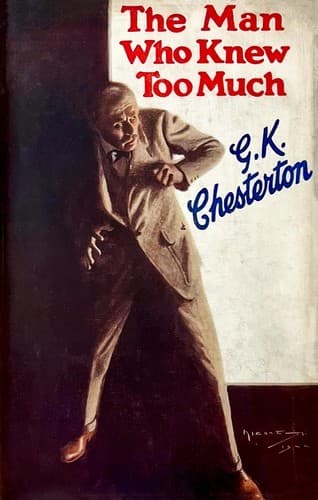
The Man Who Knew Too MuchChesterton, G. K. (Gilbert Keith)
ReligionComparative
The Man Who Knew Too Much
Chesterton, G. K. (Gilbert Keith)
Aristocracy (Social class) -- Fiction; Detective and mystery stories, English; Great Britain -- Fiction
Perhaps it increased his annoyance that there was a certain unusual
liveliness about the usually languid figure of Fisher. The ordinary
image of him in March's mind was that of a pallid and bald-browed
gentleman, who seemed to be prematurely old as well as prematurely
bald. He was remembered as a man who expressed the opinions of a
pessimist in the language of a lounger. Even now March could not be
certain whether the change was merely a sort of masquerade of
sunshine, or that effect of clear colors and clean-cut outlines that
is always visible on the parade of a marine resort, relieved against
the blue dado of the sea. But Fisher had a flower in his buttonhole,
and his friend could have sworn he carried his cane with something
almost like the swagger of a fighter. With such clouds gathering
over England, the pessimist seemed to be the only man who carried
his own sunshine.
"Look here," said Harold March, abruptly, "you've been no end of a
friend to me, and I never was so proud of a friendship before; but
there's something I must get off my chest. The more I found out, the
less I understood how you could stand it. And I tell you I'm going
to stand it no longer."
Horne Fisher gazed across at him gravely and attentively, but rather
as if he were a long way off.
"You know I always liked you," said Fisher, quietly, "but I also
respect you, which is not always the same thing. You may possibly
guess that I like a good many people I don't respect. Perhaps it is
my tragedy, perhaps it is my fault. But you are very different, and
I promise you this: that I will never try to keep you as somebody to
be liked, at the price of your not being respected."
"I know you are magnanimous," said March after a silence, "and yet
you tolerate and perpetuate everything that is mean." Then after
another silence he added: "Do you remember when we first met, when
you were fishing in that brook in the affair of the target? And do
you remember you said that, after all, it might do no harm if I
could blow the whole tangle of this society to hell with dynamite."
"Yes, and what of that?" asked Fisher.
"Only that I'm going to blow it to hell with dynamite," said Harold
March, "and I think it right to give you fair warning. For a long
time I didn't believe things were as bad as you said they were. But
I never felt as if I could have bottled up what you knew, supposing
you really knew it. Well, the long and the short of it is that I've
got a conscience; and now, at last, I've also got a chance. I've
been put in charge of a big independent paper, with a free hand, and
we're going to open a cannonade on corruption."
"That will be--Attwood, I suppose," said Fisher, reflectively.
"Timber merchant. Knows a lot about China."
Public-domain text, read in full here on John Shaqi.
Reviews
Reviews
No reviews yet
Be the first to share your thoughts on this work.
Elsewhere in the archive
Join the Discussion
Join the discussion
Sign in to leave a comment or review.
Sign InorCreate an account