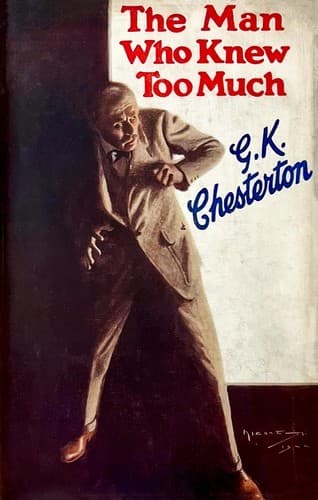
The Man Who Knew Too MuchChesterton, G. K. (Gilbert Keith)
ReligionComparative
The Man Who Knew Too Much
Chesterton, G. K. (Gilbert Keith)
Aristocracy (Social class) -- Fiction; Detective and mystery stories, English; Great Britain -- Fiction
By the time that Horne Fisher had ended his telling of this story to
Harold March they had come out into one of the public parks and
taken a seat on a rise of ground overlooking wide green spaces under
a blue and empty sky; and there was something incongruous in the
words with which the narration ended.
"I have been in that room ever since," said Horne Fisher. "I am in
it now. I won the election, but I never went to the House. My life
has been a life in that little room on that lonely island. Plenty of
books and cigars and luxuries, plenty of knowledge and interest and
information, but never a voice out of that tomb to reach the world
outside. I shall probably die there." And he smiled as he looked
across the vast green park to the gray horizon.
VIII. THE VENGEANCE OF THE STATUE
It was on the sunny veranda of a seaside hotel, overlooking a
pattern of flower beds and a strip of blue sea, that Horne Fisher
and Harold March had their final explanation, which might be called
an explosion.
Harold March had come to the little table and sat down at it with a
subdued excitement smoldering in his somewhat cloudy and dreamy blue
eyes. In the newspapers which he tossed from him on to the table
there was enough to explain some if not all of his emotion. Public
affairs in every department had reached a crisis. The government
which had stood so long that men were used to it, as they are used
to a hereditary despotism, had begun to be accused of blunders and
even of financial abuses. Some said that the experiment of
attempting to establish a peasantry in the west of England, on the
lines of an early fancy of Horne Fisher's, had resulted in nothing
but dangerous quarrels with more industrial neighbors. There had
been particular complaints of the ill treatment of harmless
foreigners, chiefly Asiatics, who happened to be employed in the new
scientific works constructed on the coast. Indeed, the new Power
which had arisen in Siberia, backed by Japan and other powerful
allies, was inclined to take the matter up in the interests of its
exiled subjects; and there had been wild talk about ambassadors and
ultimatums. But something much more serious, in its personal
interest for March himself, seemed to fill his meeting with his
friend with a mixture of embarrassment and indignation.
Public-domain text, read in full here on John Shaqi.
Reviews
Reviews
No reviews yet
Be the first to share your thoughts on this work.
Elsewhere in the archive
Join the Discussion
Join the discussion
Sign in to leave a comment or review.
Sign InorCreate an account