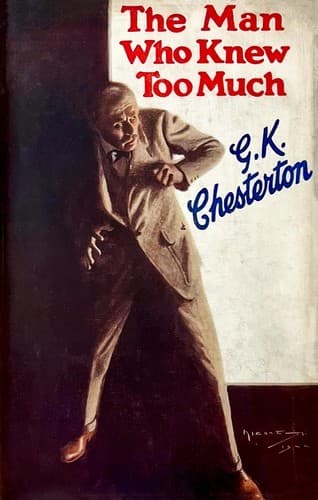
The Man Who Knew Too MuchChesterton, G. K. (Gilbert Keith)
ReligionComparative
The Man Who Knew Too Much
Chesterton, G. K. (Gilbert Keith)
Aristocracy (Social class) -- Fiction; Detective and mystery stories, English; Great Britain -- Fiction
Horne Fisher evidently allowed for all the neurotic possibilities of
Archer and the dissipated habits of Herries; and whatever his faith
in their present firmness, did not unduly tax their time and
attention, even in the case of the Prime Minister. He had got the
consent of the latter finally to the committing of the important
documents, with the orders to the Western armies, to the care of a
less conspicuous and more solid person--an uncle of his named Horne
Hewitt, a rather colorless country squire who had been a good
soldier, and was the military adviser of the committee. He was
charged with expediting the government pledge, along with the
concerted military plans, to the half-mutinous command in the west;
and the still more urgent task of seeing that it did not fall into
the hands of the enemy, who might appear at any moment from the
east. Over and above this military official, the only other person
present was a police official, a certain Doctor Prince, originally a
police surgeon and now a distinguished detective, sent to be a
bodyguard to the group. He was a square-faced man with big
spectacles and a grimace that expressed the intention of keeping his
mouth shut. Nobody else shared their captivity except the hotel
proprietor, a crusty Kentish man with a crab-apple face, one or two
of his servants, and another servant privately attached to Lord
James Herries. He was a young Scotchman named Campbell, who looked
much more distinguished than his bilious-looking master, having
chestnut hair and a long saturnine face with large but fine
features. He was probably the one really efficient person in the
house.
After about four days of the informal council, March had come to
feel a sort of grotesque sublimity about these dubious figures,
defiant in the twilight of danger, as if they were hunchbacks and
cripples left alone to defend a town. All were working hard; and he
himself looked up from writing a page of memoranda in a private room
to see Horne Fisher standing in the doorway, accoutered as if for
travel. He fancied that Fisher looked a little pale; and after a
moment that gentleman shut the door behind him and said, quietly:
"Well, the worst has happened. Or nearly the worst."
"The enemy has landed," cried March, and sprang erect out of his
chair.
"Oh, I knew the enemy would land," said Fisher, with composure.
"Yes, he's landed; but that's not the worst that could happen. The
worst is that there's a leak of some sort, even from this fortress
of ours. It's been a bit of a shock to me, I can tell you; though I
suppose it's illogical. After all, I was full of admiration at
finding three honest men in politics. I ought not to be full of
astonishment if I find only two."
He ruminated a moment and then said, in such a fashion that March
could hardly tell if he were changing the subject or no:
Public-domain text, read in full here on John Shaqi.
Reviews
Reviews
No reviews yet
Be the first to share your thoughts on this work.
Elsewhere in the archive
Join the Discussion
Join the discussion
Sign in to leave a comment or review.
Sign InorCreate an account