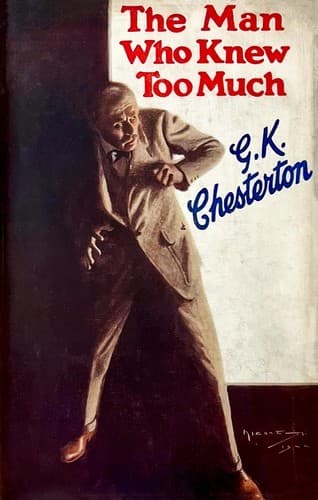
The Man Who Knew Too MuchChesterton, G. K. (Gilbert Keith)
ReligionComparative
The Man Who Knew Too Much
Chesterton, G. K. (Gilbert Keith)
Aristocracy (Social class) -- Fiction; Detective and mystery stories, English; Great Britain -- Fiction
"It's hard at first to believe that a fellow like Herries, who had
pickled himself in vice like vinegar, can have any scruple left. But
about that I've noticed a curious thing. Patriotism is not the first
virtue. Patriotism rots into Prussianism when you pretend it is the
first virtue. But patriotism is sometimes the last virtue. A man
will swindle or seduce who will not sell his country. But who
knows?"
"But what is to be done?" cried March, indignantly.
"My uncle has the papers safe enough," replied Fisher, "and is
sending them west to-night; but somebody is trying to get at them
from outside, I fear with the assistance of somebody inside. All
I can do at present is to try to head off the man outside; and I
must get away now and do it. I shall be back in about twenty-four
hours. While I'm away I want you to keep an eye on these people and
find out what you can. Au revoir." He vanished down the stairs; and
from the window March could see him mount a motor cycle and trail
away toward the neighboring town.
On the following morning, March was sitting in the window seat of
the old inn parlor, which was oak-paneled and ordinarily rather
dark; but on that occasion it was full of the white light of a
curiously clear morning--the moon had shone brilliantly for the
last two or three nights. He was himself somewhat in shadow in the
corner of the window seat; and Lord James Herries, coming in hastily
from the garden behind, did not see him. Lord James clutched the
back of a chair, as if to steady himself, and, sitting down abruptly
at the table, littered with the last meal, poured himself out a
tumbler of brandy and drank it. He sat with his back to March, but
his yellow face appeared in a round mirror beyond and the tinge of it
was like that of some horrible malady. As March moved he started
violently and faced round.
"My God!" he cried, "have you seen what's outside?"
"Outside?" repeated the other, glancing over his shoulder at the
garden.
"Oh, go and look for yourself," cried Herries in a sort of fury.
"Hewitt's murdered and his papers stolen, that's all."
He turned his back again and sat down with a thud; his square
shoulders were shaking. Harold March darted out of the doorway into
the back garden with its steep slope of statues.
The first thing he saw was Doctor Prince, the detective, peering
through his spectacles at something on the ground; the second was
the thing he was peering at. Even after the sensational news he had
heard inside, the sight was something of a sensation.
The monstrous stone image of Britannia was lying prone and face
downward on the garden path; and there stuck out at random from
underneath it, like the legs of a smashed fly, an arm clad in a
white shirt sleeve and a leg clad in a khaki trouser, and hair of
the unmistakable sandy gray that belonged to Horne Fisher's
unfortunate uncle. There were pools of blood and the limbs were
quite stiff in death.
Public-domain text, read in full here on John Shaqi.
Reviews
Reviews
No reviews yet
Be the first to share your thoughts on this work.
Elsewhere in the archive
Join the Discussion
Join the discussion
Sign in to leave a comment or review.
Sign InorCreate an account