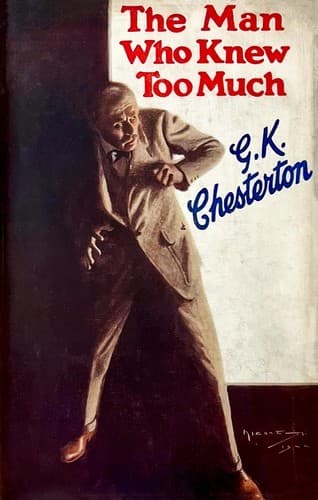
The Man Who Knew Too MuchChesterton, G. K. (Gilbert Keith)
ReligionComparative
The Man Who Knew Too Much
Chesterton, G. K. (Gilbert Keith)
Aristocracy (Social class) -- Fiction; Detective and mystery stories, English; Great Britain -- Fiction
"Couldn't this have been an accident?" said March, finding words at
last.
"Look for yourself, I say," repeated the harsh voice of Herries, who
had followed him with restless movements out of the door. "The
papers are gone, I tell you. The fellow tore the coat off the corpse
and cut the papers out of the inner pocket. There's the coat over
there on the bank, with the great slash in it."
"But wait a minute," said the detective, Prince, quietly. "In that
case there seems to be something of a mystery. A murderer might
somehow have managed to throw the statue down on him, as he seems to
have done. But I bet he couldn't easily have lifted it up again.
I've tried; and I'm sure it would want three men at least. Yet we
must suppose, on that theory, that the murderer first knocked him
down as he walked past, using the statue as a stone club, then
lifted it up again, took him out and deprived him of his coat, then
put him back again in the posture of death and neatly replaced the
statue. I tell you it's physically impossible. And how else could he
have unclothed a man covered with that stone monument? It's worse
than the conjurer's trick, when a man shuffles a coat off with his
wrists tied."
"Could he have thrown down the statue after he'd stripped the
corpse?" asked March.
"And why?" asked Prince, sharply. "If he'd killed his man and got
his papers, he'd be away like the wind. He wouldn't potter about in
a garden excavating the pedestals of statues. Besides--Hullo, who's
that up there?"
High on the ridge above them, drawn in dark thin lines against the
sky, was a figure looking so long and lean as to be almost spidery.
The dark silhouette of the head showed two small tufts like horns;
and they could almost have sworn that the horns moved.
"Archer!" shouted Herries, with sudden passion, and called to him
with curses to come down. The figure drew back at the first cry,
with an agitated movement so abrupt as almost to be called an antic.
The next moment the man seemed to reconsider and collect himself,
and began to come down the zigzag garden path, but with obvious
reluctance, his feet falling in slower and slower rhythm. Through
March's mind were throbbing the phrases that this man himself had
used, about going mad in the middle of the night and wrecking the
stone figure. Just so, he could fancy, the maniac who had done such
a thing might climb the crest of the hill, in that feverish dancing
fashion, and look down on the wreck he had made. But the wreck he
had made here was not only a wreck of stone.
When the man emerged at last on to the garden path, with the full
light on his face and figure, he was walking slowly indeed, but
easily, and with no appearance of fear.
"This is a terrible thing," he said. "I saw it from above; I was
taking a stroll along the ridge."
"Do you mean that you saw the murder?" demanded March, "or the
accident? I mean did you see the statue fall?"
"No," said Archer, "I mean I saw the statue fallen."
Public-domain text, read in full here on John Shaqi.
Reviews
Reviews
No reviews yet
Be the first to share your thoughts on this work.
Elsewhere in the archive
Join the Discussion
Join the discussion
Sign in to leave a comment or review.
Sign InorCreate an account