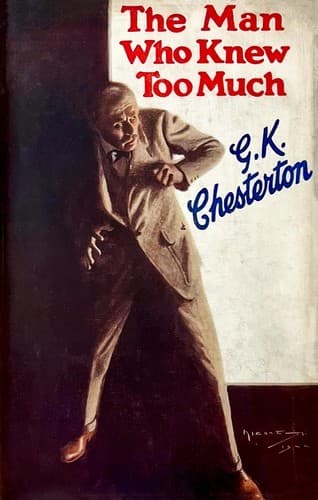
The Man Who Knew Too MuchChesterton, G. K. (Gilbert Keith)
ReligionComparative
The Man Who Knew Too Much
Chesterton, G. K. (Gilbert Keith)
Aristocracy (Social class) -- Fiction; Detective and mystery stories, English; Great Britain -- Fiction
"It was a fantastic coincidence," reflected Horne Fisher. "It's
extraordinary what coincidences do sometimes occur. By the oddest
chance in the world, by one chance in a million, it so happened that
another sword of exactly the same shape was in the same garden at
the same time. It may be partly explained, by the fact that I
brought them both into the garden myself . . . come, my dear fellow;
surely you can see now what it means. Put those two things together;
there were two duplicate swords and he took off his coat for
himself. It may assist your speculations to recall the fact that I
am not exactly an assassin."
"A duel!" exclaimed March, recovering himself. "Of course I ought
to have thought of that. But who was the spy who stole the papers?"
"My uncle was the spy who stole the papers," replied Fisher, "or who
tried to steal the papers when I stopped him--in the only way I
could. The papers, that should have gone west to reassure our
friends and give them the plans for repelling the invasion, would in
a few hours have been in the hands of the invader. What could I do?
To have denounced one of our friends at this moment would have been
to play into the hands of your friend Attwood, and all the party of
panic and slavery. Besides, it may be that a man over forty has a
subconscious desire to die as he has lived, and that I wanted, in a
sense, to carry my secrets to the grave. Perhaps a hobby hardens
with age; and my hobby has been silence. Perhaps I feel that I have
killed my mother's brother, but I have saved my mother's name.
Anyhow, I chose a time when I knew you were all asleep, and he was
walking alone in the garden. I saw all the stone statues standing in
the moonlight; and I myself was like one of those stone statues
walking. In a voice that was not my own, I told him of his treason
and demanded the papers; and when he refused, I forced him to take
one of the two swords. The swords were among some specimens sent
down here for the Prime Minister's inspection; he is a collector,
you know; they were the only equal weapons I could find. To cut an
ugly tale short, we fought there on the path in front of the
Britannia statue; he was a man of great strength, but I had somewhat
the advantage in skill. His sword grazed my forehead almost at the
moment when mine sank into the joint in his neck. He fell against
the statue, like Caesar against Pompey's, hanging on to the iron
rail; his sword was already broken. When I saw the blood from that
deadly wound, everything else went from me; I dropped my sword and
ran as if to lift him up. As I bent toward him something happened
too quick for me to follow. I do not know whether the iron bar was
rotted with rust and came away in his hand, or whether he rent it
out of the rock with his apelike strength; but the thing was in his
hand, and with his dying energies he swung it over my head, as I
knelt there unarmed beside him. I looked up wildly to avoid the
Public-domain text, read in full here on John Shaqi.
Reviews
Reviews
No reviews yet
Be the first to share your thoughts on this work.
Elsewhere in the archive
Join the Discussion
Join the discussion
Sign in to leave a comment or review.
Sign InorCreate an account