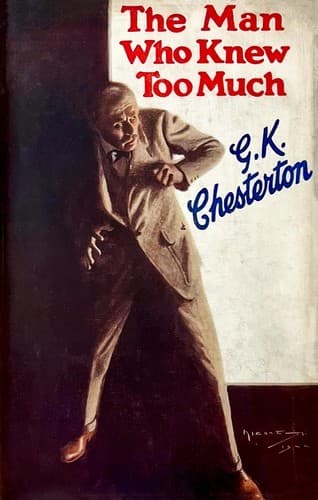
The Man Who Knew Too MuchChesterton, G. K. (Gilbert Keith)
ReligionComparative
The Man Who Knew Too Much
Chesterton, G. K. (Gilbert Keith)
Aristocracy (Social class) -- Fiction; Detective and mystery stories, English; Great Britain -- Fiction
blow, and saw above us the great bulk of Britannia leaning outward
like the figurehead of a ship. The next instant I saw it was leaning
an inch or two more than usual, and all the skies with their
outstanding stars seemed to be leaning with it. For the third second
it was as if the skies fell; and in the fourth I was standing in the
quiet garden, looking down on that flat ruin of stone and bone at
which you were looking to-day. He had plucked out the last prop that
held up the British goddess, and she had fallen and crushed the
traitor in her fall. I turned and darted for the coat which I knew
to contain the package, ripped it up with my sword, and raced away
up the garden path to where my motor bike was waiting on the road
above. I had every reason for haste; but I fled without looking back
at the statue and the body; and I think the thing I fled from was
the sight of that appalling allegory.
"Then I did the rest of what I had to do. All through the night and
into the daybreak and the daylight I went humming through the
villages and markets of South England like a traveling bullet, till
I came to the headquarters in the West where the trouble was. I was
just in time. I was able to placard the place, so to speak, with the
news that the government had not betrayed them, and that they would
find supports if they would push eastward against the enemy. There's
no time to tell you all that happened; but I tell you it was the day
of my life. A triumph like a torchlight procession, with torchlights
that might have been firebrands. The mutinies simmered down; the men
of Somerset and the western counties came pouring into the market
places; the men who died with Arthur and stood firm with Alfred. The
Irish regiments rallied to them, after a scene like a riot, and
marched eastward out of the town singing Fenian songs. There was all
that is not understood, about the dark laughter of that people, in
the delight with which, even when marching with the English to the
defense of England, they shouted at the top of their voices, 'High
upon the gallows tree stood the noble-hearted three . . . With
England's cruel cord about them cast.' However, the chorus was 'God
save Ireland,' and we could all have sung that just then, in one
sense or another.
"But there was another side to my mission. I carried the plans of
the defense; and to a great extent, luckily, the plans of the
invasion also. I won't worry you with strategics; but we knew where
the enemy had pushed forward the great battery that covered all his
movements; and though our friends from the West could hardly arrive
in time to intercept the main movement, they might get within long
artillery range of the battery and shell it, if they only knew
exactly where it was. They could hardly tell that unless somebody
round about here sent up some sort of signal. But, somehow, I rather
fancy that somebody will."
Public-domain text, read in full here on John Shaqi.
Reviews
Reviews
No reviews yet
Be the first to share your thoughts on this work.
Elsewhere in the archive
Join the Discussion
Join the discussion
Sign in to leave a comment or review.
Sign InorCreate an account