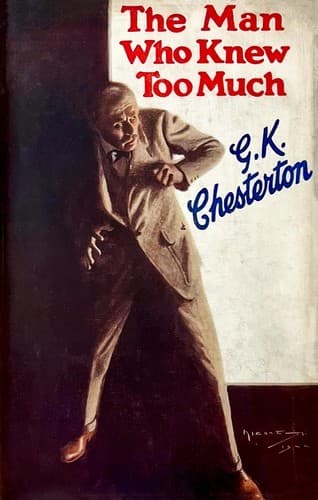
The Man Who Knew Too MuchChesterton, G. K. (Gilbert Keith)
ReligionComparative
The Man Who Knew Too Much
Chesterton, G. K. (Gilbert Keith)
Aristocracy (Social class) -- Fiction; Detective and mystery stories, English; Great Britain -- Fiction
With that he got up from the table, and they remounted their
machines and went eastward into the advancing twilight of evening.
The levels of the landscape were repeated in flat strips of floating
cloud and the last colors of day clung to the circle of the horizon.
Receding farther and farther behind them was the semicircle of the
last hills; and it was quite suddenly that they saw afar off the dim
line of the sea. It was not a strip of bright blue as they had seen
it from the sunny veranda, but of a sinister and smoky violet, a
tint that seemed ominous and dark. Here Horne Fisher dismounted once
more.
"We must walk the rest of the way," he said, "and the last bit of
all I must walk alone."
He bent down and began to unstrap something from his bicycle. It was
something that had puzzled his companion all the way in spite of
what held him to more interesting riddles; it appeared to be several
lengths of pole strapped together and wrapped up in paper. Fisher
took it under his arm and began to pick his way across the turf. The
ground was growing more tumbled and irregular and he was walking
toward a mass of thickets and small woods; night grew darker every
moment. "We must not talk any more," said Fisher. "I shall whisper
to you when you are to halt. Don't try to follow me then, for it
will only spoil the show; one man can barely crawl safely to the
spot, and two would certainly be caught."
"I would follow you anywhere," replied March, "but I would halt,
too, if that is better."
"I know you would," said his friend in a low voice. "Perhaps you're
the only man I ever quite trusted in this world."
A few paces farther on they came to the end of a great ridge or
mound looking monstrous against the dim sky; and Fisher stopped with
a gesture. He caught his companion's hand and wrung it with a
violent tenderness, and then darted forward into the darkness. March
could faintly see his figure crawling along under the shadow of the
ridge, then he lost sight of it, and then he saw it again standing
on another mound two hundred yards away. Beside him stood a singular
erection made apparently of two rods. He bent over it and there was
the flare of a light; all March's schoolboy memories woke in him,
and he knew what it was. It was the stand of a rocket. The confused,
incongruous memories still possessed him up to the very moment of a
fierce but familiar sound; and an instant after the rocket left its
perch and went up into endless space like a starry arrow aimed at
the stars. March thought suddenly of the signs of the last days and
knew he was looking at the apocalyptic meteor of something like a
Day of judgment.
Public-domain text, read in full here on John Shaqi.
Reviews
Reviews
No reviews yet
Be the first to share your thoughts on this work.
Elsewhere in the archive
Join the Discussion
Join the discussion
Sign in to leave a comment or review.
Sign InorCreate an account