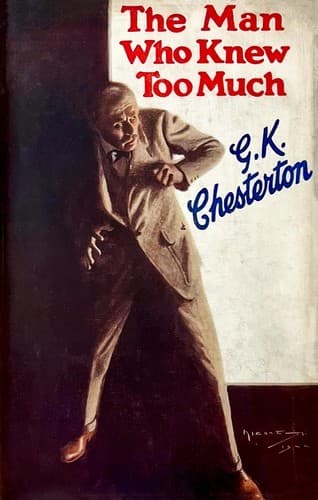
The Man Who Knew Too MuchChesterton, G. K. (Gilbert Keith)
ReligionComparative
The Man Who Knew Too Much
Chesterton, G. K. (Gilbert Keith)
Aristocracy (Social class) -- Fiction; Detective and mystery stories, English; Great Britain -- Fiction
He hurried out to the entrance and was soon exchanging greetings
with a big handsome man in a fur coat, who brought into the dingy
little station the indescribable glow of the great cities and the
luxuries of the great world.
For this was Sir Walter Carey, an official of such eminence in
Dublin Castle that nothing short of the case of Prince Michael would
have brought him on such a journey in the middle of the night. But
the case of Prince Michael, as it happened, was complicated by
legalism as well as lawlessness. On the last occasion he had escaped
by a forensic quibble and not, as usual, by a private escapade; and
it was a question whether at the moment he was amenable to the law
or not. It might be necessary to stretch a point, but a man like Sir
Walter could probably stretch it as far as he liked.
Whether he intended to do so was a question to be considered.
Despite the almost aggressive touch of luxury in the fur coat, it
soon became apparent that Sir Walter's large leonine head was for
use as well as ornament, and he considered the matter soberly and
sanely enough. Five chairs were set round the plain deal table, for
who should Sir Walter bring with him but his young relative and
secretary, Horne Fisher. Sir Walter listened with grave attention,
and his secretary with polite boredom, to the string of episodes by
which the police had traced the flying rebel from the steps of the
hotel to the solitary tower beside the sea. There at least he was
cornered between the moors and the breakers; and the scout sent by
Wilson reported him as writing under a solitary candle, perhaps
composing another of his tremendous proclamations. Indeed, it would
have been typical of him to choose it as the place in which finally
to turn to bay. He had some remote claim on it, as on a family
castle; and those who knew him thought him capable of imitating the
primitive Irish chieftains who fell fighting against the sea.
"I saw some queer-looking people leaving as I came in," said Sir
Walter Carey. "I suppose they were your witnesses. But why do they
turn up here at this time of night?"
Morton smiled grimly. "They come here by night because they would
be dead men if they came here by day. They are criminals committing
a crime that is more horrible here than theft or murder."
"What crime do you mean?" asked the other, with some curiosity.
"They are helping the law," said Morton.
There was a silence, and Sir Walter considered the papers before him
with an abstracted eye. At last he spoke.
"Quite so; but look here, if the local feeling is as lively as that
there are a good many points to consider. I believe the new Act will
enable me to collar him now if I think it best. But is it best? A
serious rising would do us no good in Parliament, and the government
has enemies in England as well as Ireland. It won't do if I have
done what looks a little like sharp practice, and then only raised a
revolution."
Public-domain text, read in full here on John Shaqi.
Reviews
Reviews
No reviews yet
Be the first to share your thoughts on this work.
Join the Discussion
Join the discussion
Sign in to leave a comment or review.
Sign InorCreate an account