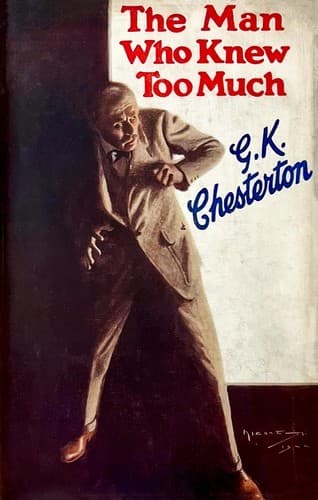
The Man Who Knew Too MuchChesterton, G. K. (Gilbert Keith)
ReligionComparative
The Man Who Knew Too Much
Chesterton, G. K. (Gilbert Keith)
Aristocracy (Social class) -- Fiction; Detective and mystery stories, English; Great Britain -- Fiction
"Well, I know that banshee," said Wilson, cheerfully, "ignorant as
you think I am of these things. I talked to that banshee myself an
hour ago, and I sent that banshee up to the tower and told her to
sing out like that if she could get a glimpse of our friend writing
his proclamation."
"Do you mean that girl Bridget Royce?" asked Morton, drawing his
frosty brows together. "Has she turned king's evidence to that
extent?"
"Yes," answered Wilson. "I know very little of these local things,
you tell me, but I reckon an angry woman is much the same in all
countries."
Nolan, however, seemed still moody and unlike himself. "It's an ugly
noise and an ugly business altogether," he said. "If it's really the
end of Prince Michael it may well be the end of other things as
well. When the spirit is on him he would escape by a ladder of dead
men, and wade through that sea if it were made of blood."
"Is that the real reason of your pious alarms?" asked Wilson, with a
slight sneer.
The Irishman's pale face blackened with a new passion.
"I have faced as many murderers in County Clare as you ever fought
with in Clapham Junction, Mr. Cockney," he said.
"Hush, please," said Morton, sharply. "Wilson, you have no kind of
right to imply doubt of your superior's conduct. I hope you will
prove yourself as courageous and trustworthy as he has always been."
The pale face of the red-haired man seemed a shade paler, but he was
silent and composed, and Sir Walter went up to Nolan with marked
courtesy, saying, "Shall we go outside now, and get this business
done?"
Dawn had lifted, leaving a wide chasm of white between a great gray
cloud and the great gray moorland, beyond which the tower was
outlined against the daybreak and the sea.
Something in its plain and primitive shape vaguely suggested the
dawn in the first days of the earth, in some prehistoric time when
even the colors were hardly created, when there was only blank
daylight between cloud and clay. These dead hues were relieved only
by one spot of gold--the spark of the candle alight in the window
of the lonely tower, and burning on into the broadening daylight. As
the group of detectives, followed by a cordon of policemen, spread
out into a crescent to cut off all escape, the light in the tower
flashed as if it were moved for a moment, and then went out. They
knew the man inside had realized the daylight and blown out his
candle.
"There are other windows, aren't there?" asked Morton, "and a door,
of course, somewhere round the corner? Only a round tower has no
corners."
Public-domain text, read in full here on John Shaqi.
Reviews
Reviews
No reviews yet
Be the first to share your thoughts on this work.
Join the Discussion
Join the discussion
Sign in to leave a comment or review.
Sign InorCreate an account