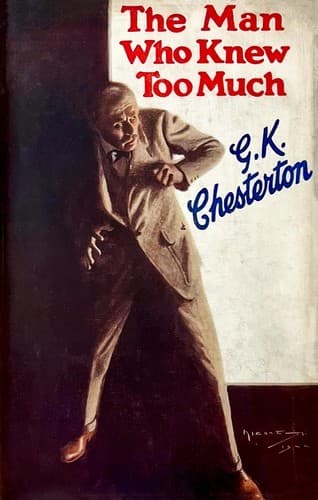
The Man Who Knew Too MuchChesterton, G. K. (Gilbert Keith)
ReligionComparative
The Man Who Knew Too Much
Chesterton, G. K. (Gilbert Keith)
Aristocracy (Social class) -- Fiction; Detective and mystery stories, English; Great Britain -- Fiction
Sir Walter straightened himself and called out something that was
lost in another noise of firing; it was possible that the police
were already avenging their comrade from the other side. Fisher had
already raced round to the next window, and a new cry of
astonishment from him brought his patron to the same spot. Nolan,
the Irish policeman, had also fallen, sprawling all his great length
in the grass, and it was red with his blood. He was still alive when
they reached him, but there was death on his face, and he was only
able to make a final gesture telling them that all was over; and,
with a broken word and a heroic effort, motioning them on to where
his other comrades were besieging the back of the tower. Stunned by
these rapid and repeated shocks, the two men could only vaguely obey
the gesture, and, finding their way to the other windows at the
back, they discovered a scene equally startling, if less final and
tragic. The other two officers were not dead or mortally wounded,
but Macbride lay with a broken leg and his ladder on top of him,
evidently thrown down from the top window of the tower; while Wilson
lay on his face, quite still as if stunned, with his red head among
the gray and silver of the sea holly. In him, however, the impotence
was but momentary, for he began to move and rise as the others came
round the tower.
"My God! it's like an explosion!" cried Sir Walter; and indeed it
was the only word for this unearthly energy, by which one man had
been able to deal death or destruction on three sides of the same
small triangle at the same instant.
Wilson had already scrambled to his feet and with splendid energy
flew again at the window, revolver in hand. He fired twice into the
opening and then disappeared in his own smoke; but the thud of his
feet and the shock of a falling chair told them that the intrepid
Londoner had managed at last to leap into the room. Then followed a
curious silence; and Sir Walter, walking to the window through the
thinning smoke, looked into the hollow shell of the ancient tower.
Except for Wilson, staring around him, there was nobody there.
The inside of the tower was a single empty room, with nothing but a
plain wooden chair and a table on which were pens, ink and paper,
and the candlestick. Halfway up the high wall there was a rude
timber platform under the upper window, a small loft which was more
like a large shelf. It was reached only by a ladder, and it seemed
to be as bare as the bare walls. Wilson completed his survey of the
place and then went and stared at the things on the table. Then he
silently pointed with his lean forefinger at the open page of the
large notebook. The writer had suddenly stopped writing, even in the
middle of a word.
"I said it was like an explosion," said Sir Walter Carey at last.
"And really the man himself seems to have suddenly exploded. But he
has blown himself up somehow without touching the tower. He's burst
more like a bubble than a bomb."
Public-domain text, read in full here on John Shaqi.
Reviews
Reviews
No reviews yet
Be the first to share your thoughts on this work.
Join the Discussion
Join the discussion
Sign in to leave a comment or review.
Sign InorCreate an account