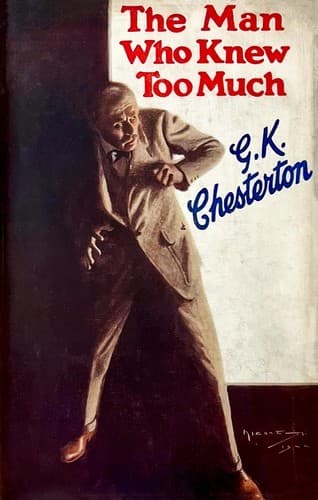
The Man Who Knew Too MuchChesterton, G. K. (Gilbert Keith)
ReligionComparative
The Man Who Knew Too Much
Chesterton, G. K. (Gilbert Keith)
Aristocracy (Social class) -- Fiction; Detective and mystery stories, English; Great Britain -- Fiction
For Summers Minor had indeed nothing to do with it; and it is part
of his higher significance that he has really nothing to do with the
story, or with any such stories. The boy went like a bullet through
the tangle of this tale of crooked politics and crazy mockery and
came out on the other side, pursuing his own unspoiled purposes.
From the top of the chimney he climbed he had caught sight of a new
omnibus, whose color and name he had never known, as a naturalist
might see a new bird or a botanist a new flower. And he had been
sufficiently enraptured in rushing after it, and riding away upon
that fairy ship.
IV. THE BOTTOMLESS WELL
In an oasis, or green island, in the red and yellow seas of sand
that stretch beyond Europe toward the sunrise, there can be found a
rather fantastic contrast, which is none the less typical of such a
place, since international treaties have made it an outpost of the
British occupation. The site is famous among archaeologists for
something that is hardly a monument, but merely a hole in the
ground. But it is a round shaft, like that of a well, and probably a
part of some great irrigation works of remote and disputed date,
perhaps more ancient than anything in that ancient land. There is a
green fringe of palm and prickly pear round the black mouth of the
well; but nothing of the upper masonry remains except two bulky and
battered stones standing like the pillars of a gateway of nowhere,
in which some of the more transcendental archaeologists, in certain
moods at moonrise or sunset, think they can trace the faint lines of
figures or features of more than Babylonian monstrosity; while the
more rationalistic archaeologists, in the more rational hours of
daylight, see nothing but two shapeless rocks. It may have been
noticed, however, that all Englishmen are not archaeologists. Many
of those assembled in such a place for official and military
purposes have hobbies other than archaeology. And it is a solemn
fact that the English in this Eastern exile have contrived to make a
small golf links out of the green scrub and sand; with a comfortable
clubhouse at one end of it and this primeval monument at the other.
They did not actually use this archaic abyss as a bunker, because it
was by tradition unfathomable, and even for practical purposes
unfathomed. Any sporting projectile sent into it might be counted
most literally as a lost ball. But they often sauntered round it in
their interludes of talking and smoking cigarettes, and one of them
had just come down from the clubhouse to find another gazing
somewhat moodily into the well.
Both the Englishmen wore light clothes and white pith helmets and
puggrees, but there, for the most part, their resemblance ended. And
they both almost simultaneously said the same word, but they said it
on two totally different notes of the voice.
"Have you heard the news?" asked the man from the club. "Splendid."
Public-domain text, read in full here on John Shaqi.
Reviews
Reviews
No reviews yet
Be the first to share your thoughts on this work.
Join the Discussion
Join the discussion
Sign in to leave a comment or review.
Sign InorCreate an account