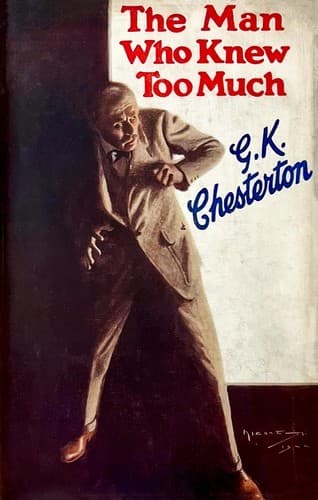
The Man Who Knew Too MuchChesterton, G. K. (Gilbert Keith)
ReligionComparative
The Man Who Knew Too Much
Chesterton, G. K. (Gilbert Keith)
Aristocracy (Social class) -- Fiction; Detective and mystery stories, English; Great Britain -- Fiction
Fisher did not see his friend until a fortnight later, when he found
himself in the garden at the back of the clubhouse on the opposite
side from the links, a garden heavily colored and scented with sweet
semitropical plants in the glow of a desert sunset. Two other men
were with him, the third being the now celebrated second in command,
familiar to everybody as Tom Travers, a lean, dark man, who looked
older than his years, with a furrow in his brow and something morose
about the very shape of his black mustache. They had just been
served with black coffee by the Arab now officiating as the
temporary servant of the club, though he was a figure already
familiar, and even famous, as the old servant of the general. He
went by the name of Said, and was notable among other Semites for
that unnatural length of his yellow face and height of his narrow
forehead which is sometimes seen among them, and gave an irrational
impression of something sinister, in spite of his agreeable smile.
"I never feel as if I could quite trust that fellow," said Grayne,
when the man had gone away. "It's very unjust, I take it, for he was
certainly devoted to Hastings, and saved his life, they say. But
Arabs are often like that, loyal to one man. I can't help feeling he
might cut anybody else's throat, and even do it treacherously."
"Well," said Travers, with a rather sour smile, "so long as he
leaves Hastings alone the world won't mind much."
There was a rather embarrassing silence, full of memories of the
great battle, and then Horne Fisher said, quietly:
"The newspapers aren't the world, Tom. Don't you worry about them.
Everybody in your world knows the truth well enough."
"I think we'd better not talk about the general just now," remarked
Grayne, "for he's just coming out of the club."
"He's not coming here," said Fisher. "He's only seeing his wife to
the car."
As he spoke, indeed, the lady came out on the steps of the club,
followed by her husband, who then went swiftly in front of her to
open the garden gate. As he did so she turned back and spoke for a
moment to a solitary man still sitting in a cane chair in the shadow
of the doorway, the only man left in the deserted club save for the
three that lingered in the garden. Fisher peered for a moment into
the shadow, and saw that it was Captain Boyle.
The next moment, rather to their surprise, the general reappeared
and, remounting the steps, spoke a word or two to Boyle in his turn.
Then he signaled to Said, who hurried up with two cups of coffee,
and the two men re-entered the club, each carrying his cup in his
hand. The next moment a gleam of white light in the growing darkness
showed that the electric lamps had been turned on in the library
beyond.
"Coffee and scientific researches," said Travers, grimly. "All the
luxuries of learning and theoretical research. Well, I must be
going, for I have my work to do as well." And he got up rather
stiffly, saluted his companions, and strode away into the dusk.
Public-domain text, read in full here on John Shaqi.
Reviews
Reviews
No reviews yet
Be the first to share your thoughts on this work.
Join the Discussion
Join the discussion
Sign in to leave a comment or review.
Sign InorCreate an account