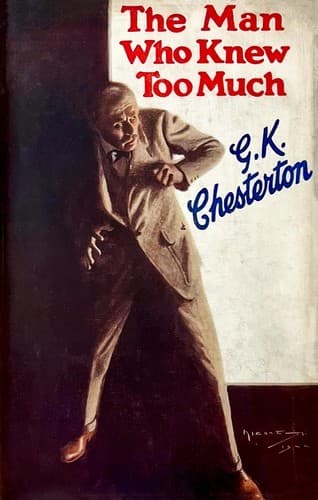
The Man Who Knew Too MuchChesterton, G. K. (Gilbert Keith)
ReligionComparative
The Man Who Knew Too Much
Chesterton, G. K. (Gilbert Keith)
Aristocracy (Social class) -- Fiction; Detective and mystery stories, English; Great Britain -- Fiction
Dawn had begun to break abrupt and white when Cuthbert Grayne turned
out the lights in the library and came out on to the links. Fisher
was lounging about alone, in his listless fashion; but the police
messenger for whom he had sent was standing at attention in the
background.
"I sent Boyle off with Travers," observed Fisher, carelessly; "he'll
look after him, and he'd better have some sleep, anyhow."
"Did you get anything out of him?" asked Grayne. "Did he tell you
what he and Hastings were doing?"
"Yes," answered Fisher, "he gave me a pretty clear account, after
all. He said that after Lady Hastings went off in the car the
general asked him to take coffee with him in the library and look up
a point about local antiquities. He himself was beginning to look
for Budge's book in one of the revolving bookstands when the general
found it in one of the bookshelves on the wall. After looking at
some of the plates they went out, it would seem, rather abruptly, on
to the links, and walked toward the old well; and while Boyle was
looking into it he heard a thud behind him, and turned round to find
the general lying as we found him. He himself dropped on his knees
to examine the body, and then was paralyzed with a sort of terror
and could not come nearer to it or touch it. But I think very little
of that; people caught in a real shock of surprise are sometimes
found in the queerest postures."
Grayne wore a grim smile of attention, and said, after a short
silence:
"Well, he hasn't told you many lies. It's really a creditably clear
and consistent account of what happened, with everything of
importance left out."
"Have you discovered anything in there?" asked Fisher.
"I have discovered everything," answered Grayne.
Fisher maintained a somewhat gloomy silence, as the other resumed
his explanation in quiet and assured tones.
"You were quite right, Fisher, when you said that young fellow was
in danger of going down dark ways toward the pit. Whether or no, as
you fancied, the jolt you gave to his view of the general had
anything to do with it, he has not been treating the general well
for some time. It's an unpleasant business, and I don't want to
dwell on it; but it's pretty plain that his wife was not treating
him well, either. I don't know how far it went, but it went as far
as concealment, anyhow; for when Lady Hastings spoke to Boyle it was
to tell him she had hidden a note in the Budge book in the library.
The general overheard, or came somehow to know, and he went straight
to the book and found it. He confronted Boyle with it, and they had
a scene, of course. And Boyle was confronted with something else; he
was confronted with an awful alternative, in which the life of one
old man meant ruin and his death meant triumph and even happiness."
"Well," observed Fisher, at last, "I don't blame him for not telling
you the woman's part of the story. But how do you know about the
letter?"
Public-domain text, read in full here on John Shaqi.
Reviews
Reviews
No reviews yet
Be the first to share your thoughts on this work.
Join the Discussion
Join the discussion
Sign in to leave a comment or review.
Sign InorCreate an account