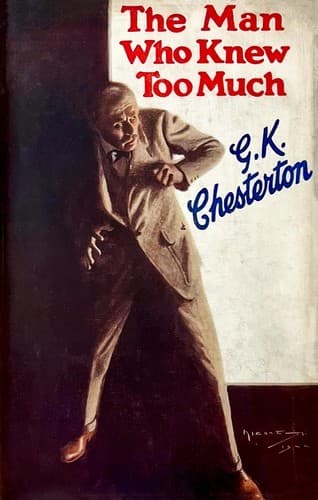
The Man Who Knew Too MuchChesterton, G. K. (Gilbert Keith)
ReligionComparative
The Man Who Knew Too Much
Chesterton, G. K. (Gilbert Keith)
Aristocracy (Social class) -- Fiction; Detective and mystery stories, English; Great Britain -- Fiction
Even before reaching the shrine of his political pilgrimage he had
many other things to think of besides the odd incident of the
bridge; for the management of a boat by a solitary man was not
always easy even on such a solitary stream. And indeed it was only
by an unforeseen accident that he was solitary. The boat had been
purchased and the whole expedition planned in conjunction with a
friend, who had at the last moment been forced to alter all his
arrangements. Harold March was to have traveled with his friend
Horne Fisher on that inland voyage to Willowood Place, where the
Prime Minister was a guest at the moment. More and more people were
hearing of Harold March, for his striking political articles were
opening to him the doors of larger and larger salons; but he had
never met the Prime Minister yet. Scarcely anybody among the general
public had ever heard of Horne Fisher; but he had known the Prime
Minister all his life. For these reasons, had the two taken the
projected journey together, March might have been slightly disposed
to hasten it and Fisher vaguely content to lengthen it out. For
Fisher was one of those people who are born knowing the Prime
Minister. The knowledge seemed to have no very exhilarant effect,
and in his case bore some resemblance to being born tired. But he
was distinctly annoyed to receive, just as he was doing a little
light packing of fishing tackle and cigars for the journey, a
telegram from Willowood asking him to come down at once by train, as
the Prime Minister had to leave that night. Fisher knew that his
friend the journalist could not possibly start till the next day,
and he liked his friend the journalist, and had looked forward to a
few days on the river. He did not particularly like or dislike the
Prime Minister, but he intensely disliked the alternative of a few
hours in the train. Nevertheless, he accepted Prime Ministers as he
accepted railway trains--as part of a system which he, at least, was
not the revolutionist sent on earth to destroy. So he telephoned to
March, asking him, with many apologetic curses and faint damns, to
take the boat down the river as arranged, that they might meet at
Willowood by the time settled; then he went outside and hailed a
taxicab to take him to the railway station. There he paused at the
bookstall to add to his light luggage a number of cheap murder
stories, which he read with great pleasure, and without any
premonition that he was about to walk into as strange a story in
real life.
Public-domain text, read in full here on John Shaqi.
Reviews
Reviews
No reviews yet
Be the first to share your thoughts on this work.
Join the Discussion
Join the discussion
Sign in to leave a comment or review.
Sign InorCreate an account