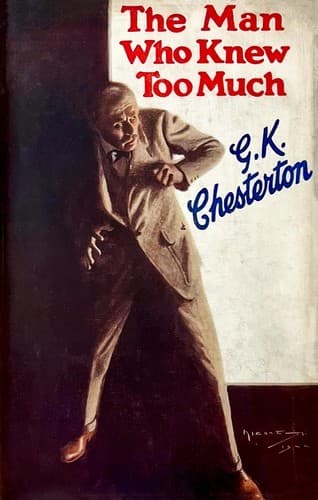
The Man Who Knew Too MuchChesterton, G. K. (Gilbert Keith)
ReligionComparative
The Man Who Knew Too Much
Chesterton, G. K. (Gilbert Keith)
Aristocracy (Social class) -- Fiction; Detective and mystery stories, English; Great Britain -- Fiction
They had started walking in the tracks of the car, leaving it behind
them in the hollow, still humming horribly like a huge insect that
had killed a man. The tracks took them to the corner of the road,
one arm of which went on in the same line toward the distant gates
of the park. It was clear that the car had been driven down the long
straight road, and then, instead of turning with the road to the
left, had gone straight on over the turf to its doom. But it was not
this discovery that had riveted Fisher's eye, but something even
more solid. At the angle of the white road a dark and solitary
figure was standing almost as still as a finger post. It was that of
a big man in rough shooting-clothes, bareheaded, and with tousled
curly hair that gave him a rather wild look. On a nearer approach
this first more fantastic impression faded; in a full light the
figure took on more conventional colors, as of an ordinary gentleman
who happened to have come out without a hat and without very
studiously brushing his hair. But the massive stature remained, and
something deep and even cavernous about the setting of the eyes
redeemed his animal good looks from the commonplace. But March had
no time to study the man more closely, for, much to his
astonishment, his guide merely observed, "Hullo, Jack!" and walked
past him as if he had indeed been a signpost, and without attempting
to inform him of the catastrophe beyond the rocks. It was relatively
a small thing, but it was only the first in a string of singular
antics on which his new and eccentric friend was leading him.
The man they had passed looked after them in rather a suspicious
fashion, but Fisher continued serenely on his way along the straight
road that ran past the gates of the great estate.
"That's John Burke, the traveler," he condescended to explain. "I
expect you've heard of him; shoots big game and all that. Sorry I
couldn't stop to introduce you, but I dare say you'll meet him later
on."
"I know his book, of course," said March, with renewed interest.
"That is certainly a fine piece of description, about their being
only conscious of the closeness of the elephant when the colossal
head blocked out the moon."
"Yes, young Halkett writes jolly well, I think. What? Didn't you
know Halkett wrote Burke's book for him? Burke can't use anything
except a gun; and you can't write with that. Oh, he's genuine enough
in his way, you know, as brave as a lion, or a good deal braver by
all accounts."
"You seem to know all about him," observed March, with a rather
bewildered laugh, "and about a good many other people."
Fisher's bald brow became abruptly corrugated, and a curious
expression came into his eyes.
"I know too much," he said. "That's what's the matter with me.
That's what's the matter with all of us, and the whole show; we know
too much. Too much about one another; too much about ourselves.
That's why I'm really interested, just now, about one thing that I
don't know."
Public-domain text, read in full here on John Shaqi.
Reviews
Reviews
No reviews yet
Be the first to share your thoughts on this work.
Join the Discussion
Join the discussion
Sign in to leave a comment or review.
Sign InorCreate an account