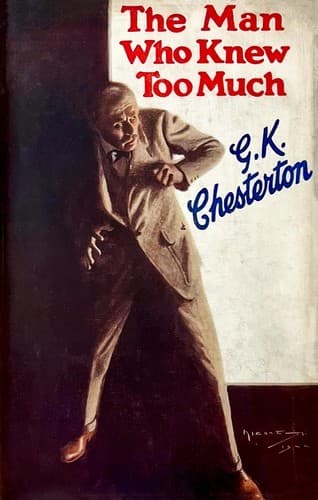
The Man Who Knew Too MuchChesterton, G. K. (Gilbert Keith)
ReligionComparative
The Man Who Knew Too Much
Chesterton, G. K. (Gilbert Keith)
Aristocracy (Social class) -- Fiction; Detective and mystery stories, English; Great Britain -- Fiction
"Aren't you going to dress up?" asked Juliet, indignantly shaking at
him a horned and towering blue headdress of the fourteenth century
which framed her face very becomingly, fantastic as it was.
"Everybody here has to be in the Middle Ages. Even Mr. Brain has put
on a sort of brown dressing gown and says he's a monk; and Mr.
Fisher got hold of some old potato sacks in the kitchen and sewed
them together; he's supposed to be a monk, too. As to the prince,
he's perfectly glorious, in great crimson robes as a cardinal. He
looks as if he could poison everybody. You simply must be
something."
"I will be something later in the day," he replied. "At present I am
nothing but an antiquary and an attorney. I have to see your brother
presently, about some legal business and also some local
investigations he asked me to make. I must look a little like a
steward when I give an account of my stewardship."
"Oh, but my brother has dressed up!" cried the girl. "Very much so.
No end, if I may say so. Why he's bearing down on you now in all his
glory."
The noble lord was indeed marching toward them in a magnificent
sixteenth-century costume of purple and gold, with a gold-hilted
sword and a plumed cap, and manners to match. Indeed, there was
something more than his usual expansiveness of bodily action in his
appearance at that moment. It almost seemed, so to speak, that the
plumes on his hat had gone to his head. He flapped his great,
gold-lined cloak like the wings of a fairy king in a pantomime; he
even drew his sword with a flourish and waved it about as he did his
walking stick. In the light of after events there seemed to be
something monstrous and ominous about that exuberance, something of
the spirit that is called fey. At the time it merely crossed a few
people's minds that he might possibly be drunk.
As he strode toward his sister the first figure he passed was that
of Leonard Crane, clad in Lincoln green, with the horn and baldrick
and sword appropriate to Robin Hood; for he was standing nearest to
the lady, where, indeed, he might have been found during a
disproportionate part of the time. He had displayed one of his
buried talents in the matter of skating, and now that the skating
was over seemed disposed to prolong the partnership. The boisterous
Bulmer playfully made a pass at him with his drawn sword, going
forward with the lunge in the proper fencing fashion, and making a
somewhat too familiar Shakespearean quotation about a rodent and a
Venetian coin.
Probably in Crane also there was a subdued excitement just then;
anyhow, in one flash he had drawn his own sword and parried; and
then suddenly, to the surprise of everyone, Bulmer's weapon seemed
to spring out of his hand into the air and rolled away on the
ringing ice.
"Well, I never!" said the lady, as if with justifiable indignation.
"You never told me you could fence, too."
Public-domain text, read in full here on John Shaqi.
Reviews
Reviews
No reviews yet
Be the first to share your thoughts on this work.
Elsewhere in the archive
Join the Discussion
Join the discussion
Sign in to leave a comment or review.
Sign InorCreate an account