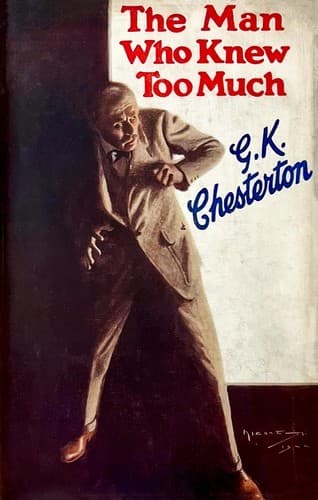
The Man Who Knew Too MuchChesterton, G. K. (Gilbert Keith)
ReligionComparative
The Man Who Knew Too Much
Chesterton, G. K. (Gilbert Keith)
Aristocracy (Social class) -- Fiction; Detective and mystery stories, English; Great Britain -- Fiction
The incongruity between the masquerade and the mystery had created a
curious psychological atmosphere. At first they had all felt
horribly ashamed at being caught in the foolish disguises of a
festival, by an event that had only too much the character of a
funeral. Many of them would have already gone back and dressed in
clothes that were more funereal or at least more formal. But somehow
at the moment this seemed like a second masquerade, more artificial
and frivolous than the first. And as they reconciled themselves to
their ridiculous trappings, a curious sensation had come over some
of them, notably over the more sensitive, like Crane and Fisher and
Juliet, but in some degree over everybody except the practical Mr.
Brain. It was almost as if they were the ghosts of their own
ancestors haunting that dark wood and dismal lake, and playing some
old part that they only half remembered. The movements of those
colored figures seemed to mean something that had been settled long
before, like a silent heraldry. Acts, attitudes, external objects,
were accepted as an allegory even without the key; and they knew
when a crisis had come, when they did not know what it was. And
somehow they knew subconsciously that the whole tale had taken a new
and terrible turn, when they saw the prince stand in the gap of the
gaunt trees, in his robes of angry crimson and with his lowering
face of bronze, bearing in his hand a new shape of death. They could
not have named a reason, but the two swords seemed indeed to have
become toy swords and the whole tale of them broken and tossed away
like a toy. Borodino looked like the Old World headsman, clad in
terrible red, and carrying the ax for the execution of the criminal.
And the criminal was not Crane.
Mr. Brain of the Indian police was glaring at the new object, and it
was a moment or two before he spoke, harshly and almost hoarsely.
"What are you doing with that?" he asked. "Seems to be a woodman's
chopper."
"A natural association of ideas," observed Horne Fisher. "If you
meet a cat in a wood you think it's a wildcat, though it may have
just strolled from the drawing-room sofa. As a matter of fact, I
happen to know that is not the woodman's chopper. It's the kitchen
chopper, or meat ax, or something like that, that somebody has
thrown away in the wood. I saw it in the kitchen myself when I was
getting the potato sacks with which I reconstructed a mediaeval
hermit."
"All the same, it is not without interest," remarked the prince,
holding out the instrument to Fisher, who took it and examined it
carefully. "A butcher's cleaver that has done butcher's work."
"It was certainly the instrument of the crime," assented Fisher, in
a low voice.
Brain was staring at the dull blue gleam of the ax head with fierce
and fascinated eyes. "I don't understand you," he said. "There is
no--there are no marks on it."
Public-domain text, read in full here on John Shaqi.
Reviews
Reviews
No reviews yet
Be the first to share your thoughts on this work.
Elsewhere in the archive
Join the Discussion
Join the discussion
Sign in to leave a comment or review.
Sign InorCreate an account