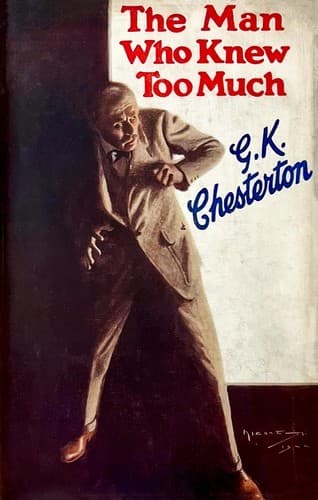
The Man Who Knew Too MuchChesterton, G. K. (Gilbert Keith)
ReligionComparative
The Man Who Knew Too Much
Chesterton, G. K. (Gilbert Keith)
Aristocracy (Social class) -- Fiction; Detective and mystery stories, English; Great Britain -- Fiction
"It has shed no blood," answered Fisher, "but for all that it has
committed a crime. This is as near as the criminal came to the crime
when he committed it."
"What do you mean?"
"He was not there when he did it," explained Fisher. "It's a poor
sort of murderer who can't murder people when he isn't there."
"You seem to be talking merely for the sake of mystification," said
Brain. "If you have any practical advice to give you might as well
make it intelligible."
"The only practical advice I can suggest," said Fisher,
thoughtfully, "is a little research into local topography and
nomenclature. They say there used to be a Mr. Prior, who had a farm
in this neighborhood. I think some details about the domestic life
of the late Mr. Prior would throw a light on this terrible
business."
"And you have nothing more immediate than your topography to offer,"
said Brain, with a sneer, "to help me avenge my friend?"
"Well," said Fisher, "I should find out the truth about the Hole in
the Wall."
* * *
That night, at the close of a stormy twilight and under a strong
west wind that followed the breaking of the frost, Leonard Crane was
wending his way in a wild rotatory walk round and round the high,
continuous wall that inclosed the little wood. He was driven by a
desperate idea of solving for himself the riddle that had clouded
his reputation and already even threatened his liberty. The police
authorities, now in charge of the inquiry, had not arrested him, but
he knew well enough that if he tried to move far afield he would be
instantly arrested. Horne Fisher's fragmentary hints, though he had
refused to expand them as yet, had stirred the artistic temperament
of the architect to a sort of wild analysis, and he was resolved to
read the hieroglyph upside down and every way until it made sense.
If it was something connected with a hole in the wall he would find
the hole in the wall; but, as a matter of fact, he was unable to
find the faintest crack in the wall. His professional knowledge told
him that the masonry was all of one workmanship and one date, and,
except for the regular entrance, which threw no light on the
mystery, he found nothing suggesting any sort of hiding place or
means of escape. Walking a narrow path between the winding wall and
the wild eastward bend and sweep of the gray and feathery trees,
seeing shifting gleams of a lost sunset winking almost like
lightning as the clouds of tempest scudded across the sky and
mingling with the first faint blue light from a slowly strengthened
moon behind him, he began to feel his head going round as his heels
were going round and round the blind recurrent barrier. He had
thoughts on the border of thought; fancies about a fourth dimension
which was itself a hole to hide anything, of seeing everything from
a new angle out of a new window in the senses; or of some mystical
light and transparency, like the new rays of chemistry, in which he
Public-domain text, read in full here on John Shaqi.
Reviews
Reviews
No reviews yet
Be the first to share your thoughts on this work.
Elsewhere in the archive
Join the Discussion
Join the discussion
Sign in to leave a comment or review.
Sign InorCreate an account