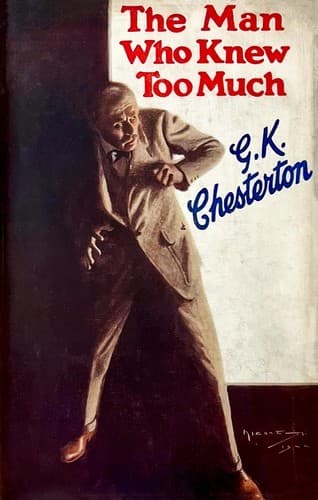
The Man Who Knew Too MuchChesterton, G. K. (Gilbert Keith)
ReligionComparative
The Man Who Knew Too Much
Chesterton, G. K. (Gilbert Keith)
Aristocracy (Social class) -- Fiction; Detective and mystery stories, English; Great Britain -- Fiction
"The only man who has an alibi," replied Fisher. "James Haddow, the
antiquarian lawyer, left the night before the fatality, but he left
that black star of death on the ice. He left abruptly, having
previously proposed to stay; probably, I think, after an ugly scene
with Bulmer, at their legal interview. As you know yourself, Bulmer
could make a man feel pretty murderous, and I rather fancy the
lawyer had himself irregularities to confess, and was in danger of
exposure by his client. But it's my reading of human nature that a
man will cheat in his trade, but not in his hobby. Haddow may have
been a dishonest lawyer, but he couldn't help being an honest
antiquary. When he got on the track of the truth about the Holy Well
he had to follow it up; he was not to be bamboozled with newspaper
anecdotes about Mr. Prior and a hole in the wall; he found out
everything, even to the exact location of the well, and he was
rewarded, if being a successful assassin can be regarded as a
reward."
"And how did you get on the track of all this hidden history?" asked
the young architect.
A cloud came across the brow of Horne Fisher. "I knew only too much
about it already," he said, "and, after all, it's shameful for me to
be speaking lightly of poor Bulmer, who has paid his penalty; but
the rest of us haven't. I dare say every cigar I smoke and every
liqueur I drink comes directly or indirectly from the harrying of
the holy places and the persecution of the poor. After all, it needs
very little poking about in the past to find that hole in the wall,
that great breach in the defenses of English history. It lies just
under the surface of a thin sheet of sham information and
instruction, just as the black and blood-stained well lies just
under that floor of shallow water and flat weeds. Oh, the ice is
thin, but it bears; it is strong enough to support us when we dress
up as monks and dance on it, in mockery of the dear, quaint old
Middle Ages. They told me I must put on fancy dress; so I did put on
fancy dress, according to my own taste and fancy. I put on the only
costume I think fit for a man who has inherited the position of a
gentleman, and yet has not entirely lost the feelings of one."
In answer to a look of inquiry, he rose with a sweeping and downward
gesture.
"Sackcloth," he said; "and I would wear the ashes as well if they
would stay on my bald head."
VII. THE TEMPLE OF SILENCE
Public-domain text, read in full here on John Shaqi.
Reviews
Reviews
No reviews yet
Be the first to share your thoughts on this work.
Elsewhere in the archive
Join the Discussion
Join the discussion
Sign in to leave a comment or review.
Sign InorCreate an account