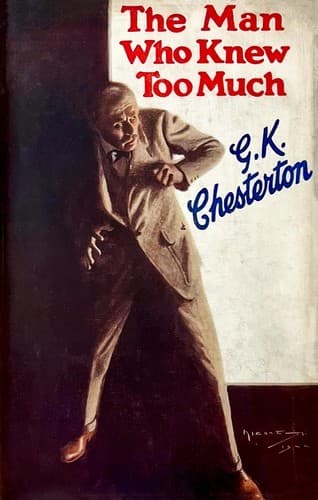
The Man Who Knew Too MuchChesterton, G. K. (Gilbert Keith)
ReligionComparative
The Man Who Knew Too Much
Chesterton, G. K. (Gilbert Keith)
Aristocracy (Social class) -- Fiction; Detective and mystery stories, English; Great Britain -- Fiction
Harold March and the few who cultivated the friendship of Horne
Fisher, especially if they saw something of him in his own social
setting, were conscious of a certain solitude in his very
sociability. They seemed to be always meeting his relations and
never meeting his family. Perhaps it would be truer to say that they
saw much of his family and nothing of his home. His cousins and
connections ramified like a labyrinth all over the governing class
of Great Britain, and he seemed to be on good, or at least on
good-humored, terms with most of them. For Horne Fisher was
remarkable for a curious impersonal information and interest
touching all sorts of topics, so that one could sometimes fancy that
his culture, like his colorless, fair mustache and pale, drooping
features, had the neutral nature of a chameleon. Anyhow, he could
always get on with viceroys and Cabinet Ministers and all the great
men responsible for great departments, and talk to each of them on
his own subject, on the branch of study with which he was most
seriously concerned. Thus he could converse with the Minister for
War about silkworms, with the Minister of Education about detective
stories, with the Minister of Labor about Limoges enamel, and with
the Minister of Missions and Moral Progress (if that be his correct
title) about the pantomime boys of the last four decades. And as the
first was his first cousin, the second his second cousin, the third
his brother-in-law, and the fourth his uncle by marriage, this
conversational versatility certainly served in one sense to create a
happy family. But March never seemed to get a glimpse of that
domestic interior to which men of the middle classes are accustomed
in their friendships, and which is indeed the foundation of
friendship and love and everything else in any sane and stable
society. He wondered whether Horne Fisher was both an orphan and an
only child.
It was, therefore, with something like a start that he found that
Fisher had a brother, much more prosperous and powerful than
himself, though hardly, March thought, so entertaining. Sir Henry
Harland Fisher, with half the alphabet after his name, was something
at the Foreign Office far more tremendous than the Foreign
Secretary. Apparently, it ran in the family, after all; for it
seemed there was another brother, Ashton Fisher, in India, rather
more tremendous than the Viceroy. Sir Henry Fisher was a heavier,
but handsomer edition of his brother, with a brow equally bald, but
much more smooth. He was very courteous, but a shade patronizing,
not only to March, but even, as March fancied, to Horne Fisher as
well. The latter gentleman, who had many intuitions about the
half-formed thoughts of others, glanced at the topic himself as they
came away from the great house in Berkeley Square.
"Why, don't you know," he observed quietly, "that I am the fool of
the family?"
"It must be a clever family," said Harold March, with a smile.
Public-domain text, read in full here on John Shaqi.
Reviews
Reviews
No reviews yet
Be the first to share your thoughts on this work.
Elsewhere in the archive
Join the Discussion
Join the discussion
Sign in to leave a comment or review.
Sign InorCreate an account