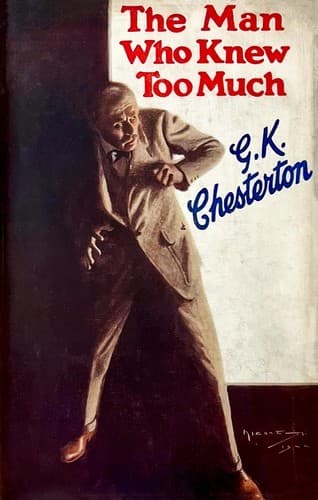
The Man Who Knew Too MuchChesterton, G. K. (Gilbert Keith)
ReligionComparative
The Man Who Knew Too Much
Chesterton, G. K. (Gilbert Keith)
Aristocracy (Social class) -- Fiction; Detective and mystery stories, English; Great Britain -- Fiction
"Very gracefully expressed," replied Fisher; "that is the best of
having a literary training. Well, perhaps it is an exaggeration to
say I am the fool of the family. It's enough to say I am the failure
of the family."
"It seems queer to me that you should fail especially," remarked the
journalist. "As they say in the examinations, what did you fail in?"
"Politics," replied his friend. "I stood for Parliament when I was
quite a young man and got in by an enormous majority, with loud
cheers and chairing round the town. Since then, of course, I've been
rather under a cloud."
"I'm afraid I don't quite understand the 'of course,'" answered
March, laughing.
"That part of it isn't worth understanding," said Fisher. "But as a
matter of fact, old chap, the other part of it was rather odd and
interesting. Quite a detective story in its way, as well as the
first lesson I had in what modern politics are made of. If you like,
I'll tell you all about it." And the following, recast in a less
allusive and conversational manner, is the story that he told.
Nobody privileged of late years to meet Sir Henry Harland Fisher
would believe that he had ever been called Harry. But, indeed, he
had been boyish enough when a boy, and that serenity which shone on
him through life, and which now took the form of gravity, had once
taken the form of gayety. His friends would have said that he was
all the more ripe in his maturity for having been young in his
youth. His enemies would have said that he was still light minded,
but no longer light hearted. But in any case, the whole of the story
Horne Fisher had to tell arose out of the accident which had made
young Harry Fisher private secretary to Lord Saltoun. Hence his
later connection with the Foreign Office, which had, indeed, come to
him as a sort of legacy from his lordship when that great man was
the power behind the throne. This is not the place to say much about
Saltoun, little as was known of him and much as there was worth
knowing. England has had at least three or four such secret
statesmen. An aristocratic polity produces every now and then an
aristocrat who is also an accident, a man of intellectual
independence and insight, a Napoleon born in the purple. His vast
work was mostly invisible, and very little could be got out of him
in private life except a crusty and rather cynical sense of humor.
But it was certainly the accident of his presence at a family dinner
of the Fishers, and the unexpected opinion he expressed, which
turned what might have been a dinner-table joke into a sort of small
sensational novel.
Public-domain text, read in full here on John Shaqi.
Reviews
Reviews
No reviews yet
Be the first to share your thoughts on this work.
Elsewhere in the archive
Join the Discussion
Join the discussion
Sign in to leave a comment or review.
Sign InorCreate an account