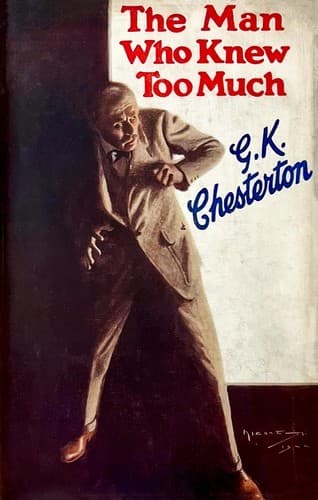
The Man Who Knew Too MuchChesterton, G. K. (Gilbert Keith)
ReligionComparative
The Man Who Knew Too Much
Chesterton, G. K. (Gilbert Keith)
Aristocracy (Social class) -- Fiction; Detective and mystery stories, English; Great Britain -- Fiction
In the rather startled silence that followed Horne Fisher sprang to
his feet and all his dreary manner dropped off him.
"I'm ready to do it to-morrow," he cried. "I suppose none of you
fellows would back me up."
Then Harry Fisher showed the finer side of his impetuosity. He made
a sudden movement as if to shake hands.
"You're a sport," he said, "and I'll back you up, if nobody else
will. But we can all back you up, can't we? I see what Lord Saltoun
means, and, of course, he's right. He's always right."
"So I will go down to Somerset," said Horne Fisher.
"Yes, it is on the way to Westminster," said Lord Saltoun, with a
smile.
And so it happened that Horne Fisher arrived some days later at the
little station of a rather remote market town in the west,
accompanied by a light suitcase and a lively brother. It must not be
supposed, however, that the brother's cheerful tone consisted
entirely of chaff. He supported the new candidate with hope as well
as hilarity; and at the back of his boisterous partnership there was
an increasing sympathy and encouragement. Harry Fisher had always
had an affection for his more quiet and eccentric brother, and was
now coming more and more to have a respect for him. As the campaign
proceeded the respect increased to ardent admiration. For Harry was
still young, and could feel the sort of enthusiasm for his captain
in electioneering that a schoolboy can feel for his captain in
cricket.
Nor was the admiration undeserved. As the new three-cornered
contest developed it became apparent to others besides his devoted
kinsman that there was more in Horne Fisher than had ever met the
eye. It was clear that his outbreak by the family fireside had been
but the culmination of a long course of brooding and studying on the
question. The talent he retained through life for studying his
subject, and even somebody else's subject, had long been
concentrated on this idea of championing a new peasantry against a
new plutocracy. He spoke to a crowd with eloquence and replied to an
individual with humor, two political arts that seemed to come to him
naturally. He certainly knew much more about rural problems than
either Hughes, the Reform candidate, or Verner, the Constitutional
candidate. And he probed those problems with a human curiosity, and
went below the surface in a way that neither of them dreamed of
doing. He soon became the voice of popular feelings that are never
found in the popular press. New angles of criticism, arguments that
had never before been uttered by an educated voice, tests and
comparisons that had been made only in dialect by men drinking in
the little local public houses, crafts half forgotten that had come
down by sign of hand and tongue from remote ages when their fathers
were free--all this created a curious and double excitement. It
startled the well informed by being a new and fantastic idea they
had never encountered. It startled the ignorant by being an old and
Public-domain text, read in full here on John Shaqi.
Reviews
Reviews
No reviews yet
Be the first to share your thoughts on this work.
Elsewhere in the archive
Join the Discussion
Join the discussion
Sign in to leave a comment or review.
Sign InorCreate an account