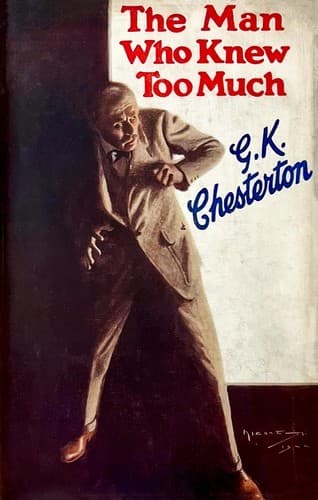
The Man Who Knew Too MuchChesterton, G. K. (Gilbert Keith)
ReligionComparative
The Man Who Knew Too Much
Chesterton, G. K. (Gilbert Keith)
Aristocracy (Social class) -- Fiction; Detective and mystery stories, English; Great Britain -- Fiction
familiar idea they never thought to have seen revived. Men saw
things in a new light, and knew not even whether it was the sunset
or the dawn.
Practical grievances were there to make the movement formidable. As
Fisher went to and fro among the cottages and country inns, it was
borne in on him without difficulty that Sir Francis Verner was a
very bad landlord. Nor was the story of his acquisition of the land
any more ancient and dignified than he had supposed; the story was
well known in the county and in most respects was obvious enough.
Hawker, the old squire, had been a loose, unsatisfactory sort of
person, had been on bad terms with his first wife (who died, as some
said, of neglect), and had then married a flashy South American
Jewess with a fortune. But he must have worked his way through this
fortune also with marvelous rapidity, for he had been compelled to
sell the estate to Verner and had gone to live in South America,
possibly on his wife's estates. But Fisher noticed that the laxity
of the old squire was far less hated than the efficiency of the new
squire. Verner's history seemed to be full of smart bargains and
financial flutters that left other people short of money and temper.
But though he heard a great deal about Verner, there was one thing
that continually eluded him; something that nobody knew, that even
Saltoun had not known. He could not find out how Verner had
originally made his money.
"He must have kept it specially dark," said Horne Fisher to himself.
"It must be something he's really ashamed of. Hang it all! what _is_
a man ashamed of nowadays?"
And as he pondered on the possibilities they grew darker and more
distorted in his mind; he thought vaguely of things remote and
repulsive, strange forms of slavery or sorcery, and then of ugly
things yet more unnatural but nearer home. The figure of Verner
seemed to be blackened and transfigured in his imagination, and to
stand against varied backgrounds and strange skies.
As he strode up a village street, brooding thus, his eyes
encountered a complete contrast in the face of his other rival, the
Reform candidate. Eric Hughes, with his blown blond hair and eager
undergraduate face, was just getting into his motor car and saying a
few final words to his agent, a sturdy, grizzled man named Gryce.
Eric Hughes waved his hand in a friendly fashion; but Gryce eyed him
with some hostility. Eric Hughes was a young man with genuine
political enthusiasms, but he knew that political opponents are
people with whom one may have to dine any day. But Mr. Gryce was a
grim little local Radical, a champion of the chapel, and one of
those happy people whose work is also their hobby. He turned his
back as the motor car drove away, and walked briskly up the sunlit
high street of the little town, whistling, with political papers
sticking out of his pocket.
Public-domain text, read in full here on John Shaqi.
Reviews
Reviews
No reviews yet
Be the first to share your thoughts on this work.
Elsewhere in the archive
Join the Discussion
Join the discussion
Sign in to leave a comment or review.
Sign InorCreate an account