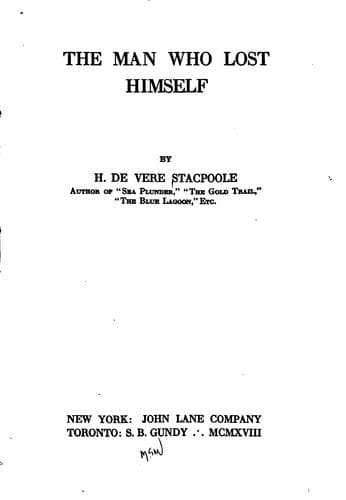
The Man Who Lost HimselfStacpoole, H. De Vere (Henry De Vere)
General
The Man Who Lost Himself
Stacpoole, H. De Vere (Henry De Vere)
Mistaken identity -- Fiction
Jones chose this wall. A tenantless dog kennel standing before it helped
him, and next moment he was over, shaken up with a drop of twelve feet
and facing a clothes line full of linen. He dived under a sheet and
almost into the back of a broad woman hanging linen on a second clothes
line, found the back door of the house, which the broad woman had left
open, ran down a passage, up a kitchen stairs and into a hall. An old
gentleman in list slippers, coming out of a room on the right, asked him
what he wanted. Jones, recalling the affair later, could hear the old
gentleman's voice and words.
He did not pause to reply. He opened the hall door, and the next moment
he was in Minerva Terrace. It was fortunately deserted. He ran to the
left, found a bye way and a terrace of artisans' dwellings, new,
hideous, and composed of yellow brick. In front of the terrace lay
fields. A gate in the hedge invited him, he climbed over it, crossed a
field, found another gate which led him to another field, and found
himself surrounded by the silence of the country, a silence pierced and
thrilled by the songs of larks. Larks make the sea lands of the south
and east coasts insufferable. One lark in a suitable setting, and, for a
while, is delightful, but twenty larks in all grades of ascent and
descent, some near, some distant, make for melancholy.
Jones crouched in a hedge for a while to get back his breath. He was
lost. Road maps were not much use to him here. The larks insisted on
that, jubilantly or sorrowfully according to the stage of their flight.
Then something or someone immediately behind him on the other side of
the hedge breathed a huge sigh, as if lamenting over his fate. He jumped
up. It was a cow. He could see her through the brambles and smell her
too, sweet as a Devonshire dairy.
Then he sat down again to think and examine the map, which he had
fortunately placed in his pocket. The roads were there but how to reach
them was the problem, and the London road, to which he had pinned his
faith, was now impossible. It would be surely watched. He determined,
after a long consultation with himself, to make for Northbourne,
striking across the fields straight ahead, and picking up the cliff road
somewhere on its course.
He judged, and rightly enough, that Hoover would hunt for him, not along
the coast but inland. Northbourne was not the road to London, even
though a train might be caught from Northbourne. The whole business was
desperate, but this course seemed the least desperate way out of it. And
he need not hurry, speed would be of no avail in this race against
Fate.
He took the money from his pocket and counted it. Out of the nine pounds
he started with from Hoover's there remained only five pounds eleven and
ninepence.
He had spent as follows:
Public-domain text, read in full here on John Shaqi.
Reviews
Reviews
No reviews yet
Be the first to share your thoughts on this work.
Elsewhere in the archive
Join the Discussion
Join the discussion
Sign in to leave a comment or review.
Sign InorCreate an account