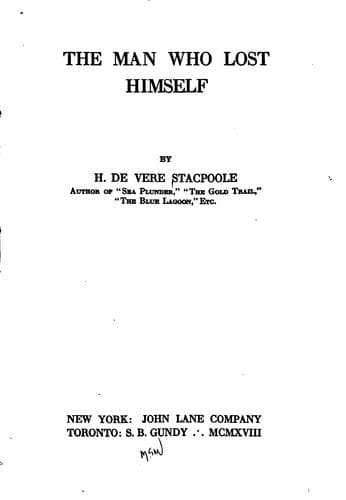
The Man Who Lost HimselfStacpoole, H. De Vere (Henry De Vere)
General
The Man Who Lost Himself
Stacpoole, H. De Vere (Henry De Vere)
Mistaken identity -- Fiction
To be Rochester was not only to be a lord, it was more than that. It was
to be famous, a national character, whose picture was printed on the
retina of the million. Never had Jones felt more inclined to stick to
his position than now, with the hounds on his traces, a tramp for his
companion, and darkness ahead. He felt that if he could once get to
London, once lay his hands on that eight thousand pounds lying in the
National Provincial Bank, he could fight. Fight for freedom, get lawyers
to help him, and retain his phantom coronet.
He had ceased to fear madness; all that dread of losing himself had
vanished, at least for the moment. Hoover had cured him.
Meanwhile they talked as they went, the tramp laying down the law as to
rights over commons and waste lands, seeming absolutely to forget that
he was talking to, or supposed to be talking to, a landed proprietor. At
last they reached the white ribbon that runs over the cliffs from
Sandbourne to Northbourne and beyond.
"Here's the road," said the tramp, "and I'll be takin' leave of your
lor'ship. I'll take it easy for a bit amongst them bushes, there's no
call for me to hurry. I shawnt forget meetin' your lor'ship. Blimy if I
will. Me sittin' there under that hedge an' thinkin' of that half quid I
dropped over 'White Lady' and your lor'ship comin' along--It gets me!"
Up to this moment of parting he had not once Lordshipped Jones.
Jones, feeling in his pocket, produced the half sovereign, which, with
five pounds one and nine pence made up his worldly wealth at the moment.
He handed it over, and the tramp spat on it for luck.
Then they parted, and the fugitive resumed his way with a lighter pocket
but a somewhat lighter heart.
There are people who increase and people who reduce one's energy, it is
sometimes enough to look at them without even talking to them. The tramp
belonged to the former class. He had cheered Jones. There was nothing
particularly cheery in his conversation, all the same the effect had
been produced.
Now, along the cliff road and coming from the direction of Northbourne a
black speck developed, resolving itself at last into the form of an old
man carrying a basket. The basket was filled with apples and Banbury
cakes. Jones bought eight Banbury cakes and two apples with his one and
nine pence, and then took his seat on the warm turf by the way to devour
them. He lay on his side as he ate and cursed Hoover.
To lie here for an hour on this idyllic day, to watch the white gulls
flying, to listen to the whisper of the sea far below, what could be
better than that? He determined if ever he should win freedom and money
to return here for a holiday.
He was thinking this, when, raised now on his elbow, he saw something
moving amongst the bushes and long grass of the waste lands bordering
the cliff road.
It was a man, a man on all fours, yet moving swiftly, a sight natural
enough in the deer-stalking Highlands, but uncanny on these Wessex
downs.
Public-domain text, read in full here on John Shaqi.
Reviews
Reviews
No reviews yet
Be the first to share your thoughts on this work.
Elsewhere in the archive
Join the Discussion
Join the discussion
Sign in to leave a comment or review.
Sign InorCreate an account