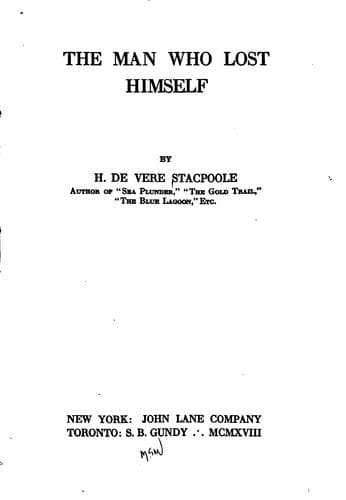
The Man Who Lost HimselfStacpoole, H. De Vere (Henry De Vere)
General
The Man Who Lost Himself
Stacpoole, H. De Vere (Henry De Vere)
Mistaken identity -- Fiction
Jones leaving four Banbury cakes uneaten on the grass, sprang to his
feet, so did the crawling one.
Then the race began.
The pursuer was handicapped.
Any two sides of a triangle are longer than the third. A right line
towards Jones would save many yards, but the going would be bad on
account of the brambles and bushes, a straight line to the road would
lenghten the distance to be covered, but would give a much better course
when the road was reached. He chose the latter.
The result was, that when the race really started the pursuer was nearly
half a mile to the bad. But he had not recently consumed four Banbury
cakes and two apples. Super-Banbury cakes of the dear old days, when
margarine was ninepence a pound, flour unlimited, and currants unsought
after by the wealthy.
Jones had not run for years. And in this connection it is quite
surprising how Society pursues a man once he gets over the barrier--and
especially when he has to run for his liberty.
The first mile was bad, then he got his second wind handed to him,
despite everything, by a fair constitution and a fairly respectable
life, but the pursuer was now only a quarter of a mile behind. Up to
this the course had been clear with no spectators, but now came along
from the direction of Northbourne an invalid on the arm of an attendant,
and behind them a boy on a bicycle. The bicycle was an inspiration.
It was also yellow painted, and bore a carrier in front blazoned with
the name of a Northbourne Italian Warehouseman. It contained parcels,
evidently intended for one of the few bungalows that strewed the cliff.
The boy fought to defend his master's property, briefly, but still he
fought, till a happy stroke in the wind laid him on the sun-warmed turf.
The screams of the invalid--it was a female--sounded in the ears of
Jones like part of some fantastic dream, so seemed the bicycle. It had
no bell, the saddle wanted raising at least two inches, still it went,
and the wind was behind.
On the right was a sheer drop of two hundred feet, and the road here
skirted the cliff edge murderously close, for the simple reason that
cliff falls had eaten the bordering grass to within a few feet of the
road. This course on an unknown and questionable bicycle laden with
parcels of tea and sugar, was open to a good many objections; they did
not occur to Jones; he was making good speed, or thought he was till the
long declivity leading to Northbourne was reached. Here he began to know
what speed really was, for he found on pressing the lever that the brake
would not act. Fortunately it was a free wheel.
This declivity runs between detached villas and stone walls, sheltering
prim gardens, right on to the west end of the esplanade, which is, in
fact, a continuation of it. For the first few hundred yards Jones
thought that nothing could go quicker than the houses and walls rushing
past him, towards the end he was not thinking.
Public-domain text, read in full here on John Shaqi.
Reviews
Reviews
No reviews yet
Be the first to share your thoughts on this work.
Elsewhere in the archive
Join the Discussion
Join the discussion
Sign in to leave a comment or review.
Sign InorCreate an account