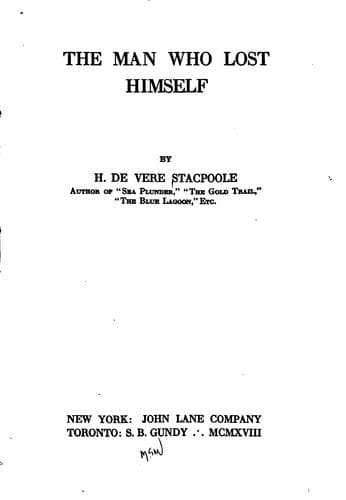
The Man Who Lost HimselfStacpoole, H. De Vere (Henry De Vere)
General
The Man Who Lost Himself
Stacpoole, H. De Vere (Henry De Vere)
Mistaken identity -- Fiction
That one word "Tosh!" uttered by the woman, in answer to what he had
said, told him more about Rochester than many statements. This man
wanted a cold bath, he wanted to be held under the tap till he cried for
mercy.
Walking, now with the stick under his right arm and his left hand in his
trousers pocket, he felt something in the pocket. It was a coin. He took
it out. It was a penny, undiscovered evidently, and unremoved by the
valet.
It was also a reminder of his own poverty stricken condition. His
thoughts turned from Rochester and his jokes, to his own immediate and
tragic position. The whole thing was his own fault. It was quite easy to
say that Rochester had led him along and tempted him; he was a full
grown man and should have resisted temptation. He had let strong drink
get hold of him; well, he had paid by the loss of his money, to say
nothing of the way his self-respect had been bruised by this jester.
Near Buckingham Palace he turned back, walking by the way he had come,
and leaving the park at the new gate.
He crossed the plexus of ways where Northumberland Avenue debouches on
Trafalgar Square. It was near twelve o'clock, and the first evening
papers were out. A hawker with a bundle of papers under his arm and a
yellow poster in front of him like an apron, drew his attention; at
least the poster did.
"Suicide of an American in London!" were the words on the poster.
Jones, remembering his penny, produced it and bought a paper.
The American's suicide did not interest him, but he fancied vaguely that
something of Rochester's doings of the night before might have been
caught by the Press through the Police news. He thought it highly
probable that Rochester, continuing his mad course, had been gaoled.
He was rewarded. Right on the first page he saw his own name. He had
never seen it before in print, and the sight and the circumstances made
his tongue cluck back, as though checked by a string tied to its root.
This was the paragraph:
"Last night, as the 11.35 Inner Circle train was entering the Temple
Station, a man was seen to jump from the platform on to the metals.
Before the station officials could interfere to save him, the
unfortunate man had thrown himself before the incoming engine. Death was
instantaneous.
"From papers in possession of deceased, his identity has been verified
as that of Mr. V. A. Jones, an American gentleman of Philadelphia,
lately resident at the Savoy Hotel, Strand."
Jones stood with the paper in his hand, appalled. Rochester had
committed suicide!
This was the Jest--the black core of it. All last evening, all through
that hilarity he had been plotting this. Plotting it perhaps from the
first moment of their meeting. Unable to resist the prompting of the
extraordinary likeness, this joker, this waster, done to the world, had
left life at the end of a last jamboree, and with a burst of
laughter--leaving another man in his clothes, nay, almost one might say
in his body.
Public-domain text, read in full here on John Shaqi.
Reviews
Reviews
No reviews yet
Be the first to share your thoughts on this work.
Join the Discussion
Join the discussion
Sign in to leave a comment or review.
Sign InorCreate an account