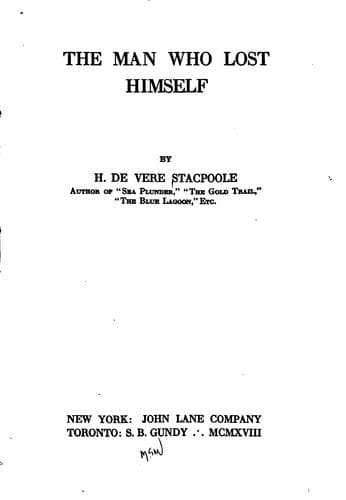
The Man Who Lost HimselfStacpoole, H. De Vere (Henry De Vere)
General
The Man Who Lost Himself
Stacpoole, H. De Vere (Henry De Vere)
Mistaken identity -- Fiction
He did not know the position of the dining room, nor did he want to. A
servant seeing him, and taking it for granted that at this late hour he
did not want to dress, opened a door.
Next minute he was seated alone at a large table, stared at by defunct
Rochesters and their wives, and spreading his table napkin on his knees.
The dinner was excellent, though simple enough. English society has
drifted a long way from the days when Lord Palmerston sat himself down
to devour two helpings of turtle soup, the same of cod and oyster sauce,
a huge plateful of York ham, a cut from the joint, a liberal supply of
roast pheasant, to say nothing of kickshaws and sweets; the days when
the inside of a nobleman after dinner was a provision store floating in
sherry, hock, champagne, old port, and punch.
Nothing acts more quickly upon the nervous system than food; before the
roast chicken and salad were served, Jones found himself enjoying his
dinner, and, more than that, enjoying his position.
The awful position of the morning had lost its terrors, the fog that had
surrounded him was breaking. Wrecked on this strange, luxuriant, yet
hostile coast, he had met the natives, fed with them, fought them, and
measured their strength and cunning.
He was not afraid of them now. The members of the Senior Conservative
Club Camp had left him unimpressed, and the wild beast Voles had
bequeathed to him a lively contempt for the mental powers of the man he
had succeeded.
Rightly or wrongly, all Lords caught a tinge of the lurid light that
shewed up Rochester's want of vim and mental hitting power.
But he did not feel a contempt for Lords as such. He was longing to
appreciate the fact that to be a Lord was to be a very great thing. Even
a Lord who had let his estates run to ruin--like himself.
A single glass of iced champagne--he allowed himself only
one--established this conviction in his mind, also the recognition that
the flunkeys no longer oppressed him, they rather pleased him. They knew
their work and performed it perfectly, they hung on his every word and
movement.
Yesterday, sitting where he was, he would have been feeling out of
place, and irritable and awkward. Even a few hours ago he would have
felt oppressed and wanting to escape somewhere by himself. What lent him
this new magic of assurance and sense of mastery of his position?
Undoubtedly it was his battle with Voles.
Coffee was served to him in the smoking room, and there, sitting alone
with a cigar, he began clearly and for the first time to envisage his
plans for the future.
He could drop everything and run. Book a passage for the United States,
enter New York as Lord Rochester, just as a diver enters the sea, and
emerge as Jones. He could keep the eight thousand pounds with a clear
conscience--or couldn't he?
This point seemed a bit obscure.
Public-domain text, read in full here on John Shaqi.
Reviews
Reviews
No reviews yet
Be the first to share your thoughts on this work.
Join the Discussion
Join the discussion
Sign in to leave a comment or review.
Sign InorCreate an account