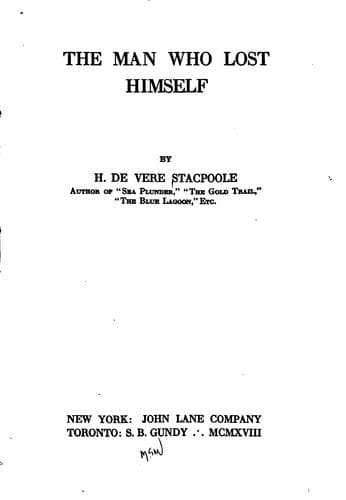
The Man Who Lost HimselfStacpoole, H. De Vere (Henry De Vere)
General
The Man Who Lost Himself
Stacpoole, H. De Vere (Henry De Vere)
Mistaken identity -- Fiction
He left the house, and, calling a taxi cab, ordered the driver to take
him to Sergeant's Inn. He had no plan of campaign as regards Collins. He
simply wanted to explore and find out about himself. Knowledge to him in
his extraordinary position was armour, and he wanted all the armour he
could get, fighting, as he was, not only the living present, but also
another man's past--and another man's character, or want of character.
CHAPTER XI
THE COAL MINE
Sergeant's Inn lies off Fleet Street, a quiet court surrounded with
houses given over to the law. The law has always lived there ever since
that time when, as Stow quaintly put it, "There is in and about the city
a whole University as it were, of students, practicers, and pleaders,
and judges of the laws of this realm, not living of common stipends, as
in other universities it is for the most part done, but of their own
private maintenance, as being fed either by their places or practices,
or otherwise by their proper revenue, or exhibition of parents or
friends--of their houses, there be at this day fourteen in all; whereof
nine do stand within the liberties of this city, and five in the suburbs
thereof."
Sergeant's Inn stood within the liberties, and there to-day it still
stands, dusty, sedate, once the abode of judges and sergeants, now the
home of solicitors. On the right of entrance lay the offices of Mortimer
Collins, an elderly man, quiet, subfusc in hue, tall, sparsely bearded,
a collector of old prints in his spare hours, and one of the most
respected members of his profession.
His practice lay chiefly amongst the nobility and landed gentry, a fact
vaguely hinted at by the white or yellow lettering on the tin deed
boxes that lined the walls of his offices, setting forth such names and
statements as: "The Cave Estate," "Sir Jardine Jardine," "The Blundell
Estate," and so forth and so on. He knew everyone, and everything about
everyone, and terrible things about some people, and he was to be met
with at the best houses. People liked him for himself, and he inspired
the trust that comes from liking.
It was to this gentleman that Jones was shown in, and it was by this
gentleman that he was received coldly, it is true, but politely.
Jones, with his usual directness, began the business.
"I have come to have a serious talk with you," said he.
"Indeed," said the lawyer, "has anything new turned up?"
"No. I want to talk about my position generally. I see that I have made
a fool of myself."
The man of law raised his hands lightly with fingers spread, the gesture
was eloquent.
"But," went on the other, "I want to make good, I want to clear up the
mess."
The lawyer sighed. Then he took a small piece of chamois leather from
his waistcoat pocket and began to polish his glasses.
"You remember what I told you the day before yesterday," said he; "have
you determined to take my advice? Then you had nothing to offer me but
some wild talk about suicide."
"What advice?"
Public-domain text, read in full here on John Shaqi.
Reviews
Reviews
No reviews yet
Be the first to share your thoughts on this work.
Join the Discussion
Join the discussion
Sign in to leave a comment or review.
Sign InorCreate an account