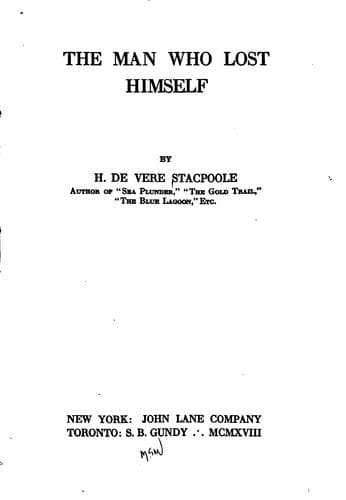
The Man Who Lost HimselfStacpoole, H. De Vere (Henry De Vere)
General
The Man Who Lost Himself
Stacpoole, H. De Vere (Henry De Vere)
Mistaken identity -- Fiction
The sight of the real thing had, however, altered the whole position.
Romance had suddenly touched Victor Jones; the gorgeous but sordid veils
through which he had been pushing had split to some mystic wand, and had
become the foliage of fairy land.
"I want to tell you--you are an old ass."
Those words were surely enough to shatter any dream, to turn to pathos
any situation. In Jones' case they had acted as a most potent spell. He
could still hear the voice, wrathful, but with a tinge of mirth in it,
golden, individual, entrancing.
"How are you to help it?" said Spence. "Why, go and make up with her
again, kick old Nichevo. Women like chaps that kick other chaps; they
pretend they don't, but they do. Either do that or take a gun and shoot
her, she'd be better shot than with that fellow."
He lit a cigarette and they passed into the card room, where Spence,
looking at his watch, declared that he must be off to keep an
appointment. They said good-bye in the street, and Jones returned to
Carlton House Terrace.
He had plenty to think about.
The pile of letters waiting to be answered on the table in the smoking
room reminded him that he had forgotten a most pressing necessity--a
typist. He could sign letters all right, with a very good imitation of
Rochester's signature, but a holograph letter in the same hand was
beyond him. Then a bright idea came to him, why not answer these letters
with sixpenny telegrams, which he could hand in himself?
He found a sheaf of telegraph forms in the bureau, and sat down before
the letters, dealing with them one by one, and as relevantly as he
could. It was a rather interesting and amusing game, and when he had
finished he felt fairly satisfied. "Awfully sorry can't come," was the
reply to the dinner invitations. The letter signed "Childersley" worried
him, till he looked up the name in "Who's Who" and found a Lord
answering to it at the same address as that on the note paper.
He had struck by accident on one of the alleviations of a major misery
of civilized life, replying to Letters, and he felt like patenting it.
He left the house with the sheaf of telegrams, found the nearest post
office--which is situated directly opposite to Charing Cross
Station--and returned. Then lighting a cigar, he took the friendly and
indefatigable "Who's Who" upon his knee, and began to turn the pages
indolently. It is a most interesting volume for an idle moment, full of
scattered romance, tales of struggle and adventure, compressed into a
few lines, peeps of history, and the epitaphs of still living men.
"I want to tell you--you are an old ass."
The words still sounding in his ears made him turn again to the name
Plinlimon. The contrast between Lady Plinlimon and the girl, whose
vision dominated his mind, rose up again sharply at sight of the printed
name.
Public-domain text, read in full here on John Shaqi.
Reviews
Reviews
No reviews yet
Be the first to share your thoughts on this work.
Join the Discussion
Join the discussion
Sign in to leave a comment or review.
Sign InorCreate an account