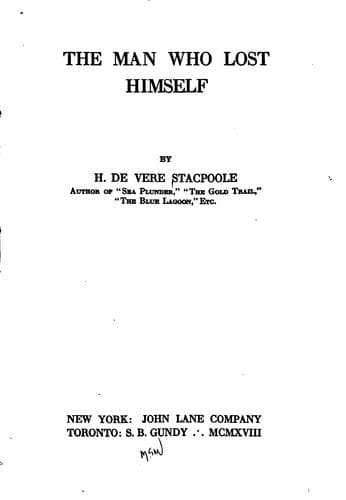
The Man Who Lost HimselfStacpoole, H. De Vere (Henry De Vere)
General
The Man Who Lost Himself
Stacpoole, H. De Vere (Henry De Vere)
Mistaken identity -- Fiction
He would tell her everything that morning. If she would not take his
word for the facts, then he would have a meeting of the whole family. He
felt absolutely certain that explaining things bit by bit and detail by
detail he could convince them of the death of Rochester and his own
existence as Jones; absolutely certain that they would not push matters
to the point of publicity. He held a trump card in the property he had
recovered from Mulhausen, were he to be exposed publicly as an impostor,
all about the Plinlimon letters, Voles and Mulhausen would come out.
Mulhausen, that very astute practitioner, would not be long in declaring
that he had been forced to return the title deeds to protect his
daughter's name. Voles would swear anything, and their case would stand
good on the proved fact that he, Jones, was a swindler. No, assuredly
the family would not press the matter to publicity.
Having drunk his tea, he arose, bathed, and dressed with a calm mind.
Then he came down stairs.
She was not in the breakfast-room, where only one place was laid, and,
concluding that she was breakfasting in her own room, he sat down to
table.
After the meal, and with another sheaf of the infernal early post
letters in his hand, he crossed to the smoking-room, where he closed the
door, put the letters on the table and lit a cigar. Then, having smoked
for a few minutes and collected his thoughts, he rang the bell and sent
for Mr. Church.
"Church," said he when that functionary arrived, "will you tell--my wife
I want to see her?"
"Her ladyship left last night, your Lordship, she left at ten o'clock,
or a little after."
"Left! where did she go to?"
"She went to the South Kensington Hotel, your Lordship."
"Good heavens! what made her--why did she go--ah, was it because I did
not come back?"
"I think it was, your Lordship."
Mr. Church spoke gravely and the least bit stiffly. It could easily be
seen that as an old servant and faithful retainer he was on the woman's
side in the business.
"I had to go out," said the other. "I will explain it to her when I see
her--It was on a matter of importance--Thanks, that will do, Church."
Alone again he finished his cigar.
The awful fear of the night before, the fear of negation and the loss of
himself had vanished with a brain refreshed by sleep and before this
fact.
What a brute he had been! She had come back forgiving him for who knows
what, she had taken his part against his traducers, kissed him. She had
fancied that all was right and that happiness had returned--and he had
coldly discarded her.
It would have been less cruel to have beaten her. She was a good sweet
woman. He knew that fact, now, both instinctively and by knowledge. He
had not known it fully till this minute.
Public-domain text, read in full here on John Shaqi.
Reviews
Reviews
No reviews yet
Be the first to share your thoughts on this work.
Elsewhere in the archive
Join the Discussion
Join the discussion
Sign in to leave a comment or review.
Sign InorCreate an account