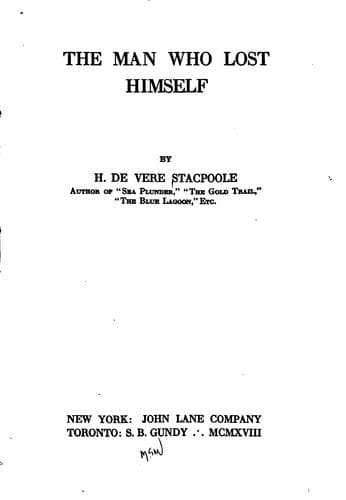
The Man Who Lost HimselfStacpoole, H. De Vere (Henry De Vere)
General
The Man Who Lost Himself
Stacpoole, H. De Vere (Henry De Vere)
Mistaken identity -- Fiction
Would it, after all, have been better to have deceived her and to have
played the part of Rochester? That question occurred to him for a moment
to be at once flung away. It was not so much personal antagonism to such
a course nor the dread of madness owing to his double life that cast it
out so violently, but the recognition of the goodness and lovableness of
the woman. Leaving everything else aside to carry on such a deception
with her, even to think of it, was impossible.
More than ever was he determined to clear this thing up and tell her
all, and, to his honour be it said, his main motive now was to do his
best by her.
He finished his cigar, and then going into the hall obtained his hat and
left the house.
He did not know where the South Kensington Hotel might be, but a taxi
solved that question and shortly before ten o'clock he reached his
destination.
Yes, Lady Rochester had arrived last night and was staying in the hotel,
and whilst the girl in the manager's office was sending up his name and
asking for an interview Jones took his seat in the lounge.
A long time--nearly ten minutes--elapsed, and then a boy brought him her
answer in the form of a letter.
He opened it.
"Never again. This is good-bye."
"T."
That was the answer.
He sat with the sheet of paper in his hand, contemplating the shape and
make of an armchair of wicker-work opposite him.
What was he to do?
He had received just the answer he might have expected, neither more nor
less. It was impossible for him to force an interview with her. He had
overthrown Voles, climbed over Mulhausen, but the flight of stairs
dividing him now from the private suite of the Countess of Rochester was
an obstacle not to be overcome by courage or direct methods, and he knew
of no indirect method.
He folded up the paper and put it in his pocket. Then he left the hotel
and took his way back to Carlton House Terrace.
If she would not see him she could not refuse to read a letter. He
would write to her and explain all. He would write in detail giving the
whole business, circumstance by circumstance. It would take him a long
while; he guessed that, and ordinary note-paper would not do. He had
seen a stack of manuscript paper, however, in one of the drawers of the
bureau, and having shut the door and lit a cigarette he took some of the
sheets of long foolscap, ruled thirty four lines to the page, and sat
down to the business. This is what he said:
"Lady Rochester,
"I want you to read what follows carefully and not to form any
opinion on the matter till all the details are before you. This
document is not a letter in the strict sense of the term, it's more
in the nature of an invoice of the cargo of stupidity and bad luck,
which I, the writer, Victor Jones of Philadelphia, have been
freighted with by an all-wise Providence for its own
incomprehensible ends."
Public-domain text, read in full here on John Shaqi.
Reviews
Reviews
No reviews yet
Be the first to share your thoughts on this work.
Elsewhere in the archive
Join the Discussion
Join the discussion
Sign in to leave a comment or review.
Sign InorCreate an account