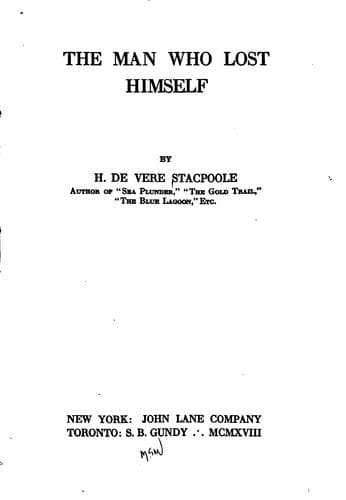
The Man Who Lost HimselfStacpoole, H. De Vere (Henry De Vere)
General
The Man Who Lost Himself
Stacpoole, H. De Vere (Henry De Vere)
Mistaken identity -- Fiction
These thoughts held him motionless for a few terrific moments. Then he
clapped his hand to his unfortunate head, turned on his side, and lay
gazing into the darkness. It had all come back to him clearly.
Rochester's wild conduct, the dinner, the smashed plates, the quarrel.
He was afraid to get up and search in his pockets, he guessed their
condition. He occupied himself instead, trying to imagine what would
become of him without money and without friends in this wilderness of
London. With ten pounds he might have done something; without, what
could he do? Nothing, unless it were manual labour, and he did not know
where to look for that.
Then Rochester, never from his mind, came more fully before him--that
likeness, was it real, or only a delusion of alcohol? And what else had
Rochester done? He seemed mad enough to have done anything, plum
crazy--would he, Jones, be held accountable for Rochester's deeds? He
was fighting with this question when a clock began to strike in the
darkness and close to the bed, nine delicate and silvery strokes, that
brought a sudden sweat upon the forehead of Jones.
He was not in his room at the Savoy. There was no clock in the Savoy bed
room, and no clock in any hotel ever spoke in tones like these. On the
sound, as if from a passage outside, he heard a voice:
"Took all his money, and sent him home in another chap's clothes."
Then came the sound of a soft step crossing the carpet, the sound of
curtain rings moving--then a blind upshrivelled letting the light of day
upon a room never before seen by Jones, a Jacobean bed room, severe, but
exquisite in every detail.
The man who had pulled the blind string, and whose powerful profile was
silhouetted against the light, showed to the sun a face highly but
evenly coloured, as though by the gentle painting of old port wine,
through a long series of years and ancestors. The typical colour of the
old fashioned English Judge, Bishop, and Butler.
He was attired in a black morning coat, and his whole countenance, make,
build and appearance had something grave and archiepiscopal most holding
to the eye and imagination.
It terrified Jones, who, breathing now as though asleep, watched
through closed eyelids whilst the apparition, with pursed lips, dealt
with the blind of the other window.
This done, it passed to the door, conferred in muted tones with some
unseen person, and returned bearing in its hands a porcelain early
morning tea service.
Having placed this on the table by the bed, the apparition vanished,
closing the door.
Jones sat up and looked around him.
His clothes had disappeared. He always hung his trousers on the bed post
at the end of his bed and placed his other things on a chair, but
trousers or other things were nowhere visible, they had been spirited
away. It was at this moment that he noticed the gorgeous silk pyjamas he
had got on. He held out his arm and looked at the texture and pattern.
Public-domain text, read in full here on John Shaqi.
Reviews
Reviews
No reviews yet
Be the first to share your thoughts on this work.
Join the Discussion
Join the discussion
Sign in to leave a comment or review.
Sign InorCreate an account