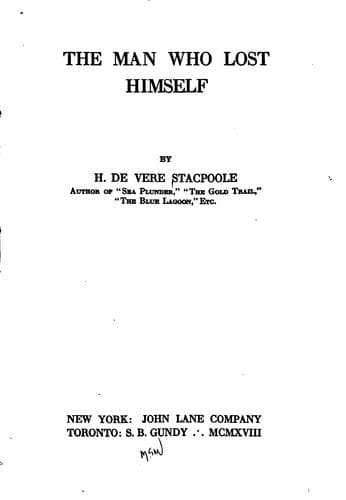
The Man Who Lost HimselfStacpoole, H. De Vere (Henry De Vere)
General
The Man Who Lost Himself
Stacpoole, H. De Vere (Henry De Vere)
Mistaken identity -- Fiction
"And later that day I opened a newspaper and saw my name and that I had
committed suicide. It was Rochester, of course, that had committed
suicide; did it on the underground.--Then I was in a nice fix. There I
was in Rochester's clothes, with not a penny in my pockets; couldn't go
to the hotel, couldn't go anywhere--so I determined to be Rochester, for
a while, at least.
"I found his affairs in an awful muddle. You know that business about
the coal mine. Well, I've managed to right his affairs. I wasn't
thinking of any profit to myself over the business, I just did it
because it was the right thing to do.
"Now I want to be perfectly plain with you. I might have carried on this
game always and lived in Rochester's shoes only for two things, one is
his wife, the other is a feeling that has been coming on me that if I
carried on any longer I might go dotty. Times I've had attacks of a
feeling that I did not know who I was. It's leading this double life,
you know. Now I want to get right back and be myself and cut clear of
all this. You can't think what it has been, carrying on this double
life, hearing the servants calling me 'your lordship.' I couldn't have
imagined it would have acted on the brain so. I've been simply crazy to
hear someone calling me by my right name--well, that's the end of the
matter, I want to settle up and get back to the States--"
The door opened and a servant appeared.
"Dr. Simms has arrived, your grace."
The Duke of Melford rose from his chair.
"One moment," said he to Jones. He left the room closing the door.
Jones tipped the ash of his cigar into a jardiniere near by.
He was astonished and a bit disturbed by the cool manner in which his
wonderful confession had been received. "Can it be they are laying low
and sending for the police?" thought he.
He was debating this question when the door opened and the Duke walked
in, followed by a bald, elderly, pleasant-looking man; after this latter
came a cadaverous gentleman, wearing glasses.
The bald man was Dr. Simms, the cadaverous, Dr. Cavendish.
Simms nodded at Jones as though he knew him.
"I have asked these gentlemen as friends of the family to step in and
talk about this matter before seeing Lady Rochester," said the Duke.
"She has been taken to her room, and is not yet prepared for visitors."
"I shall be delighted to help in any way," said Simms; "my services,
professional or private, are always at your disposal, your grace." He
sat down and turned to Jones. "Now tell us all about it," said he.
Cavendish took another chair and the Duke remained standing.
Jones felt irritated, felt somewhat as a maestro would feel who, having
finished that musical obstacle race The Grand Polonnaise, finds himself
requested to play it again.
"I've told the whole thing once," said he, "I can't go over it
again--the Duke knows."
Suddenly Cavendish spoke:
"I understand from what his grace said on the stairs, that there is some
trouble about identity?"
Public-domain text, read in full here on John Shaqi.
Reviews
Reviews
No reviews yet
Be the first to share your thoughts on this work.
Elsewhere in the archive
Join the Discussion
Join the discussion
Sign in to leave a comment or review.
Sign InorCreate an account