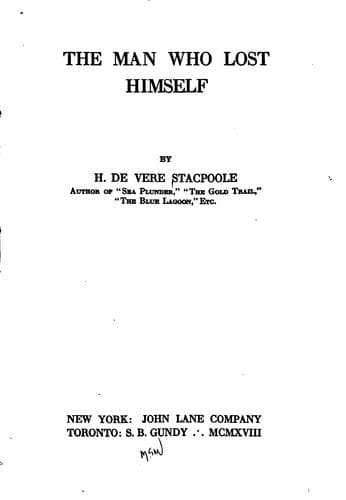
The Man Who Lost HimselfStacpoole, H. De Vere (Henry De Vere)
General
The Man Who Lost Himself
Stacpoole, H. De Vere (Henry De Vere)
Mistaken identity -- Fiction
"Some trouble," said Jones; "I reckon you are right in calling it some
trouble."
"You are Mr. Jones, I think," said Simms.
"Victor Jones was the name I was christened by," answered Jones.
"Quite so, American?"
"American."
"Now, Mr. Jones, as a matter of formality, may I ask where you live in
America?"
"Philadelphia."
"And in Philadelphia what might be your address?"
"Number one thousand, one hundred and one, Walnut Street," replied
Jones.
Cavendish averted his head for a moment and the Duke shifted his
position on the hearthrug, leaving his elbow on the mantel and caressing
for a moment his chin.
Simms alone remained unmoved.
"Just so," said Simms. "Have you any family?"
"Nope."
"I beg your pardon."
"No."
"I thought you said nope--my mistake."
"Not a bit, I did say nope--it's short for no."
"_Short_ for no--I see, just so."
Cavendish interposed with an air of interest.
"How would you spell that word?" asked he. Jones resented Cavendish
somehow.
"I don't know," said he, "this isn't a spelling bee. N-o-p-e I suspect.
You gentlemen have undertaken to question me on behalf of the family as
to my identity, I think we had better stick to that point."
"Just so," said Simms, "precisely--"
"Excuse me," said the Duke of Melford, "I think if Mr. er--Jones wishes
to prove his identity as Mr. Jones he will admit that his actions will
help. Now Lord Rochester was a very, shall we say, fastidious person,
quiet in his actions."
"Oh, was he," said Jones, "that's news."
"Quiet, that is to say, in his movements--let it stand at that. Now my
friend Collins said to me something about the eating of a document--"
Jones bristled. "Collins had no right to tell you that," said he, "I
told him that privately. When did he tell you that?"
"When I called, just after his interview with you--he did not say it in
anyway offensively. In fact he seemed to admire you for your--energy and
so forth."
"Did you, in fact, eat a document?" asked Simms, with an air of bland
interest.
"I did--and saved a very nasty situation, _and_ a million of money."
"What was the document?" asked Cavendish.
"A bill of exchange."
"Now may I ask why you did that?" queried Simms.
"No, you mayn't," replied Jones, "it's a private affair affecting the
honour of another person."
"Quite so," said Simms, "but just one more question. Did you hear a
voice telling you to--er--eat this paper?"
"Yes."
"What sort of voice was it?"
"It was the sort of voice that belongs to common-sense."
"Ha, ha," laughed Cavendish. "Good, very good,--but there is just
something I want to ask. How was it, Mr.--er--Jones, that you turned
into your present form, exchanged your position as it were with the Earl
of Rochester?"
"O Lord," said Jones. Then to the Duke of Melford, "Tell them."
"Well," said the Duke. "Mr. Jones was sitting in the lounge of an hotel
when a gentleman entered whom he knew but could not recognize."
"Couldn't place his name," cut in Jones.
Public-domain text, read in full here on John Shaqi.
Reviews
Reviews
No reviews yet
Be the first to share your thoughts on this work.
Elsewhere in the archive
Join the Discussion
Join the discussion
Sign in to leave a comment or review.
Sign InorCreate an account