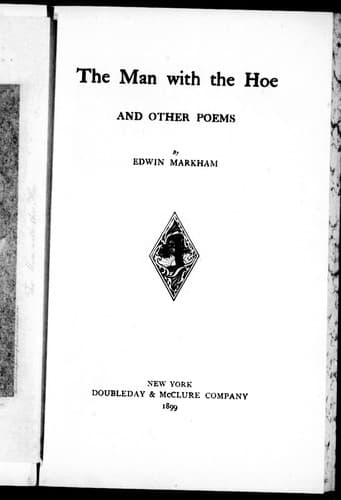
The man with the hoe, and other poemsMarkham, Edwin
General
The man with the hoe, and other poems
Markham, Edwin
American poetry -- 19th century
At the meeting of seven valleys in the west,
I came upon a host of silent souls,
Seated beside still waters on the grass.
It was a place of memories and tears--
Terrible tears. I rested in a wood,
And there the bird that mourns for Itys sang--
Itys that touched the tears of all the world.
But climbing onward toward the purple peaks,
I passed, on silent feet, white multitudes,
Beyond the reach of peering memories,
Lying asleep upon the scented banks,
Their bodies burning with celestial fire.
A mighty awe came on me at the thought--
The strangeness of the beatific sleep,
The vision of God, the mystic bread of rest.
The Rock-Breaker
Pausing he leans upon his sledge, and looks--
A labor-blasted toiler;
So have I seen, on Shasta’s top, a pine
Stand silent on a cliff,
Stript of its glory of green leaves and boughs,
Its great trunk split by fire,
Its gray bark blackened by the thunder-smoke,
Its life a sacrifice
To some blind purpose of the destinies.
These Songs Will Perish
These songs will perish like the shapes of air--
The singer and the songs die out forever;
But star-eyed Truth (greater than song or singer)
Sweeps hurrying on: far off she sees a gleam
Upon a peak. She cried to man of old
To build the enduring, glad Fraternal State--
Cries yet through all the ruins of the world--
Through Karnack, through the stones of Babylon--
Cries for a moment through these fading songs.
On wingèd feet, a form of fadeless youth,
She goes to meet the coming centuries,
And, hurrying, snatches up some human reed,
Blows through it once her terror-bearing note,
And breaks and throws away. It is enough
If we can be a bugle at her lips,
To scatter her contagion on mankind.
FOOTNOTE:
[A] This song should be read in the light of the deep and comforting
truth that the Divine Feminine as well as the Divine Masculine
Principle is in God--that he is Father-Mother, Two-in-One. It follows
from this truth that the dignity of womanhood is grounded in the Divine
Nature itself. The fact that the Deity is Man-Woman was known to the
ancient poets and sages, and was grafted into the nobler religions of
mankind. The idea is implied in the doctrine of the Divine Father,
taught by our Lord in the Gospels; and it is declared in the first
chapter of Genesis in the words: “God said, ‘Let Us make men in Our
image, after Our likeness.’ ... So God created man in His own image, in
the image of God created He him; male and female created He them.”
Public-domain text, read in full here on John Shaqi.
Reviews
Reviews
No reviews yet
Be the first to share your thoughts on this work.
Join the Discussion
Join the discussion
Sign in to leave a comment or review.
Sign InorCreate an account