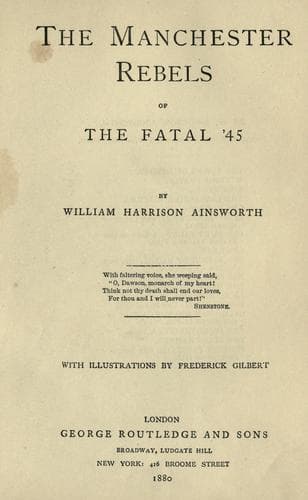
The Manchester Rebels of the Fatal '45Ainsworth, William Harrison
History
The Manchester Rebels of the Fatal '45
Ainsworth, William Harrison
Great Britain -- History -- George II, 1727-1760 -- Fiction; Jacobite Rebellion, 1745-1746 -- Fiction
"I think Sir Richard has behaved very badly to the young man, and I
will have an apology from him."
"Well, since it must be so, there is no help. Send your second to me."
"Colonel Ker will be my second. I will send him to you as soon as he
makes his appearance."
"Meantime, I will consult Sir Richard--though I don't fancy he will
apologise."
He then went in quest of the baronet, whom he soon found, while
Colonel Townley seated himself in the hall with the intention of
awaiting Atherton's return.
CHAPTER XVIII.
CAPTAIN WEIR.
Muffled in a plaid shawl, and otherwise disguised, as we have said,
the prince passed unrecognised through the guard, and taking his way
down Market Street Lane, proceeded to a short distance, and then
halted to allow Atherton to overtake him.
In uncovering the lower part of his face to speak to the young man,
Charles betrayed himself to an individual who had seen him come forth
from the mansion, and suspecting his condition, had followed him
cautiously.
This person, whose name was Weir, and who acted as a spy to the Duke
of Cumberland, had conceived the daring idea of capturing the prince,
and sending him prisoner to the duke, whose head-quarters were at
Lichfield. He had been stimulated by the hope of a large reward to
undertake this desperate project. A price of thirty thousand pounds
had been set upon Charles Edward's head, and though Weir shrank from
assassination, he had no scruples as to capturing the prince, neither
was he deterred by the extraordinary danger of the attempt. All he
wanted was an opportunity to execute his design.
Captain Weir, as he was styled, though he had no real military rank,
usually acted alone, but on this occasion he had three subordinate
officers with him, on whose courage and fidelity he could perfectly
rely. They were now close at hand, watching his movements, and waiting
for orders. Like himself, they were all well armed.
Signing to these personages to follow him, Captain Weir continued to
track the prince's course down Market Street Lane.
Meanwhile, the young Chevalier was marching along quietly, with
Atherton by his side, never for a moment imagining he was in danger,
or even that his disguise had been detected.
Scores of Highland soldiers were in the street, but none of them knew
their commander-in-chief. Had they done so, they would have formed a
guard round his person. But this was precisely what Charles objected
to. Wherever there was a crowd he strove to avoid it; but the
obstructions were frequent. He was rejoiced, however, to perceive that
the white cockade everywhere prevailed, while such observations as
reached him indicated that the populace was decidedly favourable to
his cause.
It was such honest expressions of opinion as these that he desired to
hear, and where a group of persons were talking loudly, he stopped to
listen to their discourse.
Public-domain text, read in full here on John Shaqi.
Reviews
Reviews
No reviews yet
Be the first to share your thoughts on this work.
Elsewhere in the archive
Join the Discussion
Join the discussion
Sign in to leave a comment or review.
Sign InorCreate an account