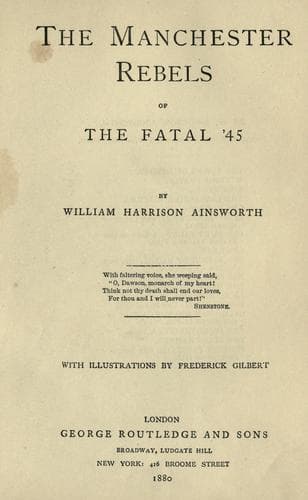
The Manchester Rebels of the Fatal '45Ainsworth, William Harrison
History
The Manchester Rebels of the Fatal '45
Ainsworth, William Harrison
Great Britain -- History -- George II, 1727-1760 -- Fiction; Jacobite Rebellion, 1745-1746 -- Fiction
As may well be supposed, he cared little for the illuminations except
as evidencing the goodwill of the townsfolk, but he was struck by the
picturesque appearance of the old houses when thus lighted up. After
several halts from one cause or other, he and Atherton at last reached
the market-place.
Here, in the centre of the area, was a large bonfire, with a great
crowd collected round it. Moreover, a barrel of ale, provided by the
magistrates, had just been broached, enabling the crowd to drink the
prince's health, coupled with that of his august sire, James the
Third, in flowing cups.
Much amused by the scene, Charles stopped to look at it, as well as to
examine the curious picture presented by the illuminated market-place.
While he was thus occupied, a sudden movement in the throng separated
him from his attendant, and he was endeavouring to free himself from
the press when a strong grasp was laid upon his arm.
The person who had thus seized him was no other than Sergeant Dickson.
"Unmuffle, and show your face, if you be not ashamed of it," cried the
sergeant. "I suspect you are a Hanoverian spy. I have heard there are
some in the town, and you don't look like a Highland officer."
"Hands off, fellow," said the prince, authoritatively. "Help me out of
the crowd."
"Help you to escape! not I!" cried Dickson. "Unmuffle, I say, and let
us see your face."
Several of the bystanders now called out, "A spy! a spy!" and Charles
would have been unpleasantly circumstanced, if Helen Carnegie, who was
near the sergeant, had not interposed.
"You are wrong, Erick," she cried. "This is no spy. Release him."
But the sergeant was not inclined to part with his prisoner, and was
only prevented from plucking the covering from his face by Atherton,
who by this time had forced his way up.
A word breathed in the ear of the sergeant instantly changed the
complexion of affairs, and he was now just as anxious to get the
prince off as he had before been to detain him.
"All right," he shouted. "His royal highness has not a better friend
than this noble gentleman. I'll answer for him. Stand back! stand
back! my masters, and let the gentleman pass."
Vigorously seconding these injunctions with his strong arm, he cleared
a way for the prince, who was soon out of the crowd; and this being
accomplished, the sergeant humbly besought pardon for his maladroit
proceeding.
"You ought to have known me under any disguise, sergeant," was the
prince's good-natured reply. "You are not half so sharp-witted as
Helen. She knew me at once."
"I canna take upon mysel to declare that, your highness," replied the
Scottish lassie, who had followed in their wake; "but I ken'd fu' weel
ye were na a fawse spy, but a leal gentleman."
"Well, sergeant, I am willing to overlook your fault for Helen's
sake," said Charles.
"I shall na sae readily forgive mysel," replied the sergeant. "But in
truth my thoughts were runnin' on spies. May I be permitted to attend
your highness?"
Public-domain text, read in full here on John Shaqi.
Reviews
Reviews
No reviews yet
Be the first to share your thoughts on this work.
Elsewhere in the archive
Join the Discussion
Join the discussion
Sign in to leave a comment or review.
Sign InorCreate an account