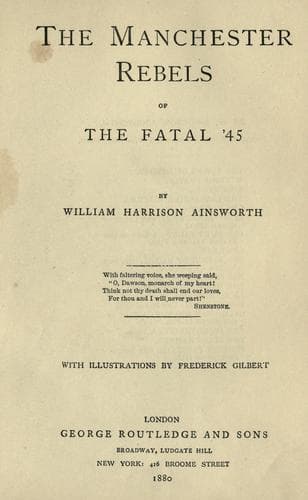
The Manchester Rebels of the Fatal '45Ainsworth, William Harrison
History
The Manchester Rebels of the Fatal '45
Ainsworth, William Harrison
Great Britain -- History -- George II, 1727-1760 -- Fiction; Jacobite Rebellion, 1745-1746 -- Fiction
"After explaining where your highness would be found, Syddall begged
to be allowed to go in quest of the villains who had assailed you,"
said Colonel Ker, "being fully persuaded that he could accomplish the
capture of their daring leader, and as Colonel Townley knew the spot
where your royal highness would be found, I did not refuse the
request."
"If the villain should be captured to-night," said Charles, "which I
think scarce likely, let him be brought before me at once. I will
interrogate him myself."
"Your commands shall be obeyed," rejoined Ker. "Shall we now return to
head-quarters?"
"By all means," replied Charles. "But march slowly."
Colonel Ker was about to give orders, when another party of soldiers,
having a prisoner in their midst, was seen advancing along the
unfinished street. The party was guided by Tom Syddall, who carried a
torch.
CHAPTER XIX.
CAPTAIN WEIR IS INTERROGATED BY THE PRINCE.
As soon as the prince was descried, the advancing party halted, and
Syddall giving the torch to one of the men, pressed forward towards
Charles, and making a profound obeisance, said:
"The villain who attacked your royal highness has been captured. He
had taken refuge in a stable at the back of the Angel Inn. He is here,
if you desire to question him."
In obedience to the prince's command the prisoner then stepped forward
between two soldiers. He did not appear intimidated by the position in
which he was placed, but bore himself very boldly.
Charles looked at him for a few moments, and calling to Atherton,
asked him if he recognised the man.
"I recognise him as the leader of the attack," was the reply.
"Such is my own opinion," observed the prince. "How say you?" he added
to the prisoner. "Do you deny the charge?"
"No," replied the prisoner. "I am the man."
"You avow your guilt," said Charles, surprised by his boldness. "How
are you named?"
"I am known as Captain Weir," replied the other.
"Have you aught to allege why you should not be delivered to the
provost-marshal for immediate execution?" observed Charles, sternly.
"My life is justly forfeited," replied the prisoner, "yet your royal
highness will do well to spare me."
"Wherefore?" demanded the prince, whose curiosity was excited.
"My reasons are only for your private ear," replied the prisoner.
After a moment's reflection, during which he kept his eye fixed on
Weir, Charles ordered the guard to retire.
"Leave the prisoner with me," he said. "But if he attempts to
fly--shoot him."
As soon as the command was obeyed, he said:
"You can speak freely now. Why should I spare your life?"
Public-domain text, read in full here on John Shaqi.
Reviews
Reviews
No reviews yet
Be the first to share your thoughts on this work.
Elsewhere in the archive
Join the Discussion
Join the discussion
Sign in to leave a comment or review.
Sign InorCreate an account