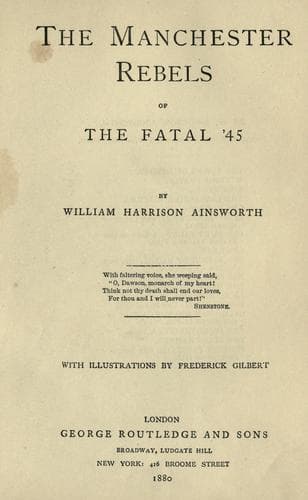
The Manchester Rebels of the Fatal '45Ainsworth, William Harrison
History
The Manchester Rebels of the Fatal '45
Ainsworth, William Harrison
Great Britain -- History -- George II, 1727-1760 -- Fiction; Jacobite Rebellion, 1745-1746 -- Fiction
"Firstly, because it will prove to the world that you are a
magnanimous prince, and in that respect superior to your enemies, who
are notorious for their severity," replied Weir. "Next, because I can
tell much that it behoves your royal highness to know, as will be
evident when I declare that I am employed by the Duke of Cumberland as
a spy, and am, therefore, necessarily in his royal highness's
confidence. If my life be spared, and I am allowed to go back to
Lichfield, where the duke is quartered, I can mislead him by erroneous
information, while I shall be able to acquaint you with his
plans--exact knowledge of which I need not say will be eminently
serviceable."
"There is much in what you say, I must own," replied the prince. "But
what guarantee have I that you will not prove a double traitor?"
"My gratitude," replied Weir. "I could never prove faithless to a
prince so generous."
"I can make no promise," replied Charles; but in a tone that held out
some encouragement to the prisoner.
At a sign from the prince the guard then advanced, and again took
charge of Weir. Shortly afterwards, the prisoner was removed, it being
understood that his execution was deferred--much to the disappointment
of the Highland guard, who would willingly have shot him.
Charles then addressed a few kindly observations to Syddall, who had
been mainly instrumental in the capture of the spy, telling him that
the service should not pass unrequited. Nor did the prince neglect to
offer his renewed thanks to Sergeant Dickson and Helen for the zeal
and devotion they had both displayed. For Atherton a signal
manifestation of favour was reserved.
During the march back to head-quarters, which were not far distant,
the prince kept the young man near him, and occasionally took his arm.
When the party arrived at the mansion in Market Street Lane they found
it completely invested by an anxious crowd, who shouted joyfully on
beholding the prince.
But this was nothing to the scene that took place when his royal
highness entered the house. Almost all the nobles and Highland chiefs
were assembled in the hall, and as Charles entered they pressed around
him to offer their warmest congratulations on his escape.
After thanking them in accents that bespoke the deepest emotion, the
prince presented Atherton to them, saying, "It is to Captain Legh that
I owe my preservation."
The young man was quite overwhelmed by the plaudits that followed this
gracious speech.
Thus ended the most important day that had hitherto occurred in
Atherton's career. It found him an unknown, and undistinguished; but
it left him apparently on the road to honour and preferment.
CHAPTER XX.
THE DUEL.
Next morning, at an early hour, Colonel Townley and Colonel Ker issued
from the prince's head-quarters, and, rather to the surprise of the
guard drawn up in the court-yard, proceeded at a quick pace along the
road leading to Stockport.
Public-domain text, read in full here on John Shaqi.
Reviews
Reviews
No reviews yet
Be the first to share your thoughts on this work.
Elsewhere in the archive
Join the Discussion
Join the discussion
Sign in to leave a comment or review.
Sign InorCreate an account