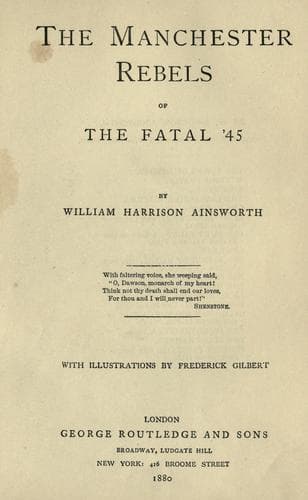
The Manchester Rebels of the Fatal '45Ainsworth, William Harrison
History
The Manchester Rebels of the Fatal '45
Ainsworth, William Harrison
Great Britain -- History -- George II, 1727-1760 -- Fiction; Jacobite Rebellion, 1745-1746 -- Fiction
In a very few minutes they had left the town behind, for beyond Market
Street Lane it was then open country. Not many persons were on the
road, and these were chiefly country folk bringing poultry, butter,
and milk to market.
Some hundred yards in advance, however, were an officer of rank in the
Highland army, and a tall middle-aged gentleman wrapped in a cloak.
These persons were evidently bent on the same errand as themselves,
and marched on quickly for about a quarter of a mile, when they
stopped at the gate of a large meadow. The ground appeared suitable to
their purpose, inasmuch as it sank at the further end, and formed a
hollow which was screened from view.
Sir Richard Rawcliffe and the Chevalier de Johnstone, for they were
the individuals who had thus halted, punctiliously saluted the others
when they came up, and Johnstone asked Colonel Ker if he thought the
ground would suit.
After consulting his principal, Ker replied in the affirmative, upon
which they all passed through the gate, and made their way to the
hollow.
Before the preliminaries of the duel were entered upon an ineffectual
effort was made by the seconds to adjust the difference. Nothing less
than an apology would satisfy Colonel Townley, but this Sir Richard
haughtily refused.
Finding their efforts fruitless, the seconds then retired--swords were
drawn--hats taken off--and instantly after the salute, the combatants
engaged--the attack being made by a thrust in carte delivered by Sir
Richard, which was well warded by his adversary.
Several passes were then exchanged, and it was evident to the
lookers-on that Colonel Townley meant to disarm his antagonist, and he
soon succeeded in the design by skilfully parrying another thrust,
seizing the shell of Sir Richard's sword, and compelling him to
surrender the weapon.
The seconds then interfered to prevent a renewal of the conflict, but
the baronet, who had received his sword from his adversary, insisted
on going on, when the clatter of horses' hoofs was heard rapidly
approaching the spot, and the next moment the prince appeared, mounted
on a splendid bay charger, and attended by an orderly.
Without waiting a moment, Charles rode down into the hollow, and
pushing between the combatants, ordered them to sheathe their swords.
Of course the command was instantly obeyed.
"A word with you, gentlemen," said the prince, sternly. "You must have
been aware that a hostile meeting between persons of your rank would
be highly displeasing to me, as well as prejudicial to our cause, and
I ought to mark my disapproval of your conduct by something more than
a reprimand, but I am willing to overlook it, provided a
reconciliation takes place between you."
Both bowed, and Colonel Townley signified his assent, but the baronet
maintained a sullen silence.
Public-domain text, read in full here on John Shaqi.
Reviews
Reviews
No reviews yet
Be the first to share your thoughts on this work.
Elsewhere in the archive
Join the Discussion
Join the discussion
Sign in to leave a comment or review.
Sign InorCreate an account