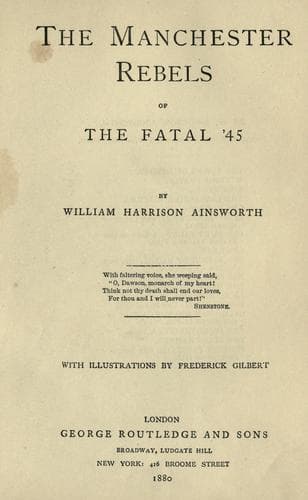
The Manchester Rebels of the Fatal '45Ainsworth, William Harrison
History
The Manchester Rebels of the Fatal '45
Ainsworth, William Harrison
Great Britain -- History -- George II, 1727-1760 -- Fiction; Jacobite Rebellion, 1745-1746 -- Fiction
Then turning to Colonel Townley, he added: "All obstacles to a perfect
reconciliation between you and Sir Richard are now removed. I hope,
therefore, to have the pleasure of seeing you shake hands, and trust
you will become as good friends as ever."
The injunction having been complied with, the prince prepared to take
his departure, saying:
"After a morning duel in France, all those engaged in it--if the
principals are fortunately unhurt, or but slightly wounded--make a
point of breakfasting together, and I don't see why the custom should
not be adopted in this country."
"Nor I," cried Colonel Townley. "I have gained an excellent appetite."
"Then I shall expect you all at breakfast an hour hence," said the
prince. "I have much to do to-day. Among other important matters I
have to attend the muster of your Manchester Regiment," he added to
Colonel Townley.
"I was afraid your royal highness might be prevented," said the
colonel. "And that would have been a great disappointment to us. I
trust you do not feel any ill effects from the rough shake you got
last night."
"A little stiffness--that is all," replied Charles.
"Have you come to any determination in regard to Weir?" inquired
Colonel Ker. "Is he to be shot?"
"No," replied the prince. "I shall send him to the Duke of Cumberland.
Now for a ride round the town. I shall be back in time for breakfast.
Au revoir!"
With this he bounded up the side of the hollow and rode off in the
direction of the town, followed by the orderly.
CHAPTER XXI.
CASTLE FIELD.
It was a fine November morning, and as the surrounding hills were
clearly distinguishable, the prince enjoyed the prospect as he
cantered along.
The atmosphere being free from smoke as well as fog, the town had a
bright, clean, and cheerful look, which it seldom wears now-a-days.
What would Charles have thought if he could have conjured up in
imagination the smoky factories and huge warehouses now covering the
pleasant orchards and gardens near which he rode?
Manchester in '45, as we have already stated, resembled a country
town, and on no side was the resemblance more complete than on this,
since not more than half a dozen scattered habitations could be
descried, the upper end of Market Street being then really a lane.
But though the outskirts of the town were quiet enough, it was evident
from the tumultuous sounds that reached the ear, not only that the
inhabitants generally were astir, but that the numerous companies
billeted upon them were likewise moving about.
The call of the bugle resounded from various quarters, and the beating
of the drum was heard in almost every street. Charles listened
delightedly to sounds that proclaimed the presence of his army. He
thought of the advance he had already made--how another week's march
would bring him to London; his breast beat high with hope and ardour;
and he fully believed at that moment that his romantic expedition
would be crowned with success.
Public-domain text, read in full here on John Shaqi.
Reviews
Reviews
No reviews yet
Be the first to share your thoughts on this work.
Elsewhere in the archive
Join the Discussion
Join the discussion
Sign in to leave a comment or review.
Sign InorCreate an account