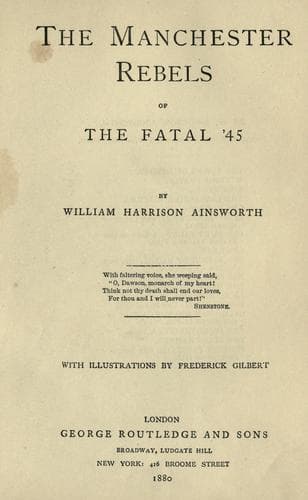
The Manchester Rebels of the Fatal '45Ainsworth, William Harrison
History
The Manchester Rebels of the Fatal '45
Ainsworth, William Harrison
Great Britain -- History -- George II, 1727-1760 -- Fiction; Jacobite Rebellion, 1745-1746 -- Fiction
Just then the bells of all the churches began to ring, and their
joyful peals heightened his enthusiasm.
Not wishing to enter the town, he commanded the orderly to guide him
to Castle Field; upon which the man rode on in front, and describing a
wide circuit then entirely unbuilt upon, but now converted into
densely-populated districts and large streets, brought him at last to
a large open piece of ground, almost encircled by the river Medlock,
and partly surrounded by the crumbling walls of an old Roman-British
castle, in the centre of which the artillery was parked.
Not far from the field-pieces were the powder carriages; while a large
portion of the area was occupied by baggage-waggons; the remainder of
the space being filled by artillerymen and their horses.
No better place in the town or neighbourhood could have been found for
the purpose. Castle Field would have accommodated double the number of
cannon, and thrice the men, it now held.
It was a very pleasant spot, and a favourite resort of the townsfolk.
Sports of various kinds took place within the ring, and an annual fair
was held there. But it had never looked more picturesque than it did
now, filled as it was with cannon, ammunition, baggage-waggons,
sumpter-horses, and men.
Early as was the hour, there were numerous spectators on the
spot--women as well as men, for the artillery was a great
attraction--and some dozens had climbed the old walls, and planted
themselves on the top, to obtain a better view of the novel scene.
As soon as the crowd collected on Castle Field became aware of the
prince's arrival, they gathered around him, cheering and expressing
heartfelt satisfaction that he had escaped the treacherous attack made
upon him overnight.
There could be no doubt from the enthusiasm displayed that the
prince's escape had greatly increased his popularity, all those who
got near him declaring they were ready to defend him to the death.
Warmly thanking them for their zeal, Charles extricated himself from
the press, and was joined by the Duke of Perth, and some officers of
artillery, with whom he rode over the field, examining different
matters as he went along.
While making this inspection he encountered many ladies, from all of
whom he received congratulations, and to whom he had something
agreeable to say.
Amongst others, whose curiosity had induced them to pay an early visit
to Castle Field, was Beppy. She had come thither, attended by Helen
Carnegie.
Charles stopped to speak to the young lady, and noticing that she was
decked in white, and wore a St. Andrew's cross, he said, "You have not
forgotten, I perceive, Miss Byrom, that this is the fête-day of our
Scottish patron saint."
"I was reminded of it by Helen Carnegie, your highness," replied
Beppy. "She came to tell me of your most fortunate escape, for which I
cannot be sufficiently grateful, and offered to make me a cross."
"No one has done me a like good turn," laughed Charles.
Public-domain text, read in full here on John Shaqi.
Reviews
Reviews
No reviews yet
Be the first to share your thoughts on this work.
Elsewhere in the archive
Join the Discussion
Join the discussion
Sign in to leave a comment or review.
Sign InorCreate an account