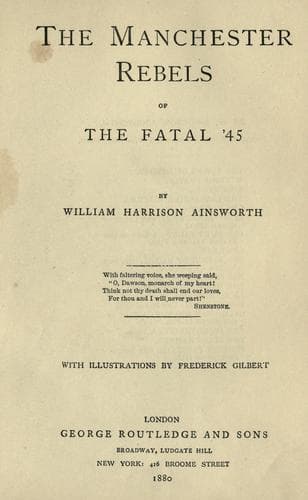
The Manchester Rebels of the Fatal '45Ainsworth, William Harrison
History
The Manchester Rebels of the Fatal '45
Ainsworth, William Harrison
Great Britain -- History -- George II, 1727-1760 -- Fiction; Jacobite Rebellion, 1745-1746 -- Fiction
Yet more imposing was the scene when the long central aisle was
crowded with officers--when the side aisles were thronged with the
townspeople, and the transepts were full of ladies. Those present on
that memorable occasion, and whose gaze ranged over the picturesque
crowd of armed mountaineers, could not fail to be struck by the tall,
graceful pillars on either side the nave, with their beautiful pointed
arches, above which rose the clerestory windows--with the exquisitely
moulded roof enriched with sculptures and other appropriate
ornaments--with the chantries--and with the splendidly carved screen
separating the choir from the nave.
The choir itself, with its fine panelled roof and its thirty
elaborately carved stalls--fifteen on each side--was reserved for the
prince, and the nobles and chiefs with him.
These stalls, with their florid tabernacle work, gloriously carved
canopies, and pendent pinnacles of extraordinary richness and beauty,
were admirably adapted to the occasion. In front of the sedilia were
book-desks, encircled with armorial bearings, cognisances, and
monograms.
Around the chancel were several exquisite chantries, most of them
possessing screens of rare workmanship; and in these chapels many
important personages connected with the town, or belonging to the
Jacobite party, were now assembled.
In the Lady chapel were some of the fellows of the church, who did not
care to make themselves too conspicuous.
In the Jesus chantry were Dr. Byrom and his family, with Mr. Walley
and Mr. Fowden; and in St. John's chapel were Dr. Deacon, Mr. Cattell,
Mr. Clayton, and several others.
But not merely was the interior of the sacred fabric thronged,
hundreds of persons who had failed to obtain admittance were collected
outside.
Precisely at eleven o'clock, Prince Charles Edward, mounted on a
richly caparisoned charger, preceded by a guard of honour, and
attended by all the nobles and chieftains belonging to his army, rode
up to the gates of the churchyard, where he alighted. A lane was
formed for him by the spectators, through which he passed, and on
entering the church by the south porch, he was ceremoniously conducted
to the choir, where he took his seat in the warden's stall.
Next to him sat the Duke of Perth, and on the same side were ranged
the Duke of Athole, Lord George Murray, Lord Kilmarnock, Lord Elcho,
Lord Ogilvy, Lord Balmerino, and the Marquis d'Eguilles. In the
opposite stalls were Lord Pitsligo, Lord Nairne, Lord Strathallan,
General Gordon of Glenbucket, Colonel Ker, Secretary Murray, and Sir
Thomas Sheridan.
From the stall occupied by the prince, which was the first on the
right of the choir, and commanded the whole interior of the edifice,
the coup-d'oeil of the nave, with its compact mass of Highlanders,
was splendid, and as Charles gazed at it, he was filled with stirring
thoughts, that were softened down, however, by the solemn sounds of
the organ pealing along the roof.
Public-domain text, read in full here on John Shaqi.
Reviews
Reviews
No reviews yet
Be the first to share your thoughts on this work.
Elsewhere in the archive
Join the Discussion
Join the discussion
Sign in to leave a comment or review.
Sign InorCreate an account