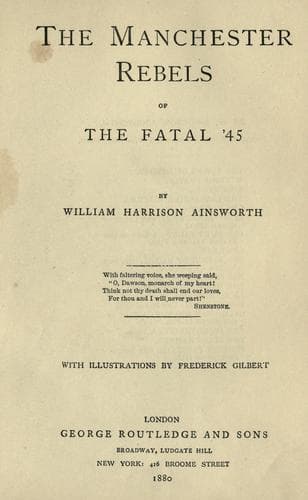
The Manchester Rebels of the Fatal '45Ainsworth, William Harrison
History
The Manchester Rebels of the Fatal '45
Ainsworth, William Harrison
Great Britain -- History -- George II, 1727-1760 -- Fiction; Jacobite Rebellion, 1745-1746 -- Fiction
Of course the Protestant form of worship was adopted; but strict
Romanist as he was, Charles allowed no symptom of disapproval to
escape him, but listened devoutly to Mr. Shrigley, who performed the
service admirably, being excited by the presence of the prince.
The reverend gentleman prayed for the king, but without naming the
sovereign. All his hearers, however, knew that James the Third was
meant.
Mr. Coppock was not so guarded. He prayed for James the Third, for
Charles Prince of Wales, Regent of England, and for the Duke of York.
Taking for his text the words "_Render unto Cæsar the things that are
Cæsar's_," he preached a most fiery sermon, in which he announced the
speedy restoration of the Stuart dynasty, and the downfall of the
House of Hanover.
Whatever might have been thought of this treasonable discourse by a
certain portion of the congregation, no voice was raised against it.
That it pleased the prince and his attendants was sufficient for the
ambitious young divine.
CHAPTER XXIV.
THE PRINCE INSPECTS THE MANCHESTER REGIMENT.
On coming forth from the church, Charles and his attendants found the
newly-formed Manchester Regiment drawn up in the churchyard.
The corps numbered about three hundred men; most of them being fine
stalwart young fellows, averaging six feet in height. Till that
morning none of them had donned their uniforms, or even shouldered a
musket, but by the exertions of Colonel Townley, the Chevalier de
Johnstone, and Sergeant Dickson, they had been got into something like
order, and now presented a very creditable appearance.
The officers looked exceedingly well in their handsome uniforms--red
faced with blue. On this occasion each wore a plaid waistcoat with
laced loops, a plaid sash lined with white silk, and had a white
cockade in his hat. In addition to the broadsword by his side, each
officer had a brace of pistols attached to his girdle.
Though all, from the colonel downwards, were fine, handsome men,
unquestionably the handsomest young man in the corps was Captain Legh.
The flag of the regiment was borne by Ensign Syddall. On one side was
the motto--LIBERTY AND PROPERTY; on the other CHURCH AND COUNTRY.
The standard-bearer looked proud of his office. Nothing now of the
barber about Ensign Syddall. So changed was his aspect, so upright his
thin figure, that he could scarcely be recognised. To look at him, no
one would believe that he could ever smile. He seemed to have grown
two or three inches taller. His deportment might be somewhat too
stiff, but he had a true military air; and his acquaintances, of whom
there were many in the crowd, regarded him with wonder and admiration.
The ensign, however, took no notice of any familiar observations
addressed to him, having become suddenly haughty and distant.
With the regiment were four field-pieces.
Public-domain text, read in full here on John Shaqi.
Reviews
Reviews
No reviews yet
Be the first to share your thoughts on this work.
Elsewhere in the archive
Join the Discussion
Join the discussion
Sign in to leave a comment or review.
Sign InorCreate an account