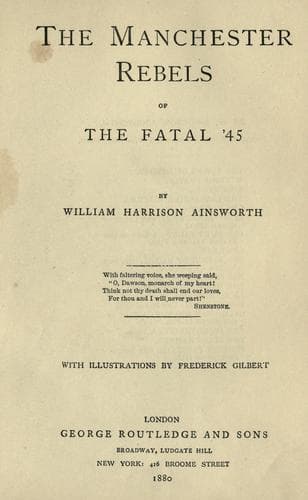
The Manchester Rebels of the Fatal '45Ainsworth, William Harrison
History
The Manchester Rebels of the Fatal '45
Ainsworth, William Harrison
Great Britain -- History -- George II, 1727-1760 -- Fiction; Jacobite Rebellion, 1745-1746 -- Fiction
Their chargers having been brought round, Charles and his suite rode
slowly past the front of the line--the prince halting occasionally to
make a commendatory remark to the men, who responded to these
gratifying observations by enthusiastic shouts.
"I am glad the flag of the regiment has been entrusted to you,
Syddall," said Charles to the new ensign. "No one, I am sure, could
take better care of it."
"I will defend it with my life," replied Syddall, earnestly.
This hasty inspection finished, Charles quitted the churchyard with
his suite, and rode back to his head-quarters.
The Manchester Regiment soon followed. Elated by the commendations of
the prince, which they flattered themselves were merited, the men
marched through the market-place, and past the Exchange to St. Ann's
square, in tolerably good order, and in high good humour, which was
not diminished by the cheers of the spectators. Colonel Townley then
gave them some necessary orders, after which they dispersed, and
repaired to their various quarters.
CHAPTER XXV.
AN UNSATISFACTORY EXPLANATION.
Having partaken of a slight repast, the prince again mounted his
charger and rode out of the town in a different direction from any he
had previously taken, being desirous to see the country.
He was only attended by Colonel Ker and the Chevalier de Johnstone,
having dismissed his guard of honour.
At that time the environs of Manchester were exceedingly pretty, and
the prospects spread out before him had a wild character of which
little can now be discerned. Smedley Hall formed the limit of his
ride, and having gazed at this picturesque old structure, which was
situated in a valley, with a clear stream flowing past it, and a range
of bleak-looking hills in the distance, he turned off on the left, and
made his way through a heathy and uncultivated district to Kersal
Moor.
From these uplands he obtained a charming view of the valley of the
Irwell, bounded by the collegiate church, and the old buildings around
it, and after contemplating the prospect for a short time, he
descended from the heights and returned to the town.
Not being expected at the time, he passed very quietly through the
streets, and reached his head-quarters without hindrance, having
greatly enjoyed his ride.
Immediately after his return a levée was held, which being more
numerously attended than that on the preceding day, occupied nearly
two hours.
After this he had a conference with the magistrates in the audience
chamber, and he then repaired to his private cabinet, where he
expected to find Sir Richard Rawcliffe and the others, whose
attendance he had commanded.
Constance was there and Atherton, but in place of the baronet appeared
Father Jerome. Repressing his displeasure, Charles graciously saluted
the party, and then addressing Constance said:
"Why is not Sir Richard here, Miss Rawcliffe?"
Public-domain text, read in full here on John Shaqi.
Reviews
Reviews
No reviews yet
Be the first to share your thoughts on this work.
Elsewhere in the archive
Join the Discussion
Join the discussion
Sign in to leave a comment or review.
Sign InorCreate an account