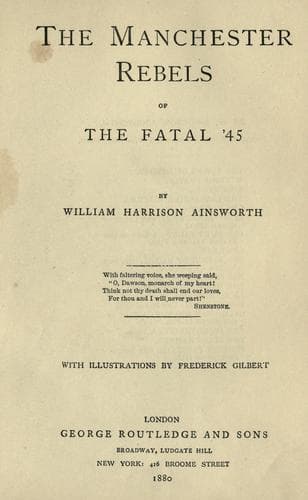
The Manchester Rebels of the Fatal '45Ainsworth, William Harrison
History
The Manchester Rebels of the Fatal '45
Ainsworth, William Harrison
Great Britain -- History -- George II, 1727-1760 -- Fiction; Jacobite Rebellion, 1745-1746 -- Fiction
The Chevalier de Johnstone understood the matter at once, and
immediately ordered the sergeant to provide two strong horses for
Captain Legh and himself, bidding him go well armed.
Although the sergeant was told by his colonel to lose no time, he
easily prevailed upon Atherton to let him bid adieu to Helen, who, as
the reader is aware, had found a lodging with Beppy Byrom.
Very little delay, however, occurred, for as the sergeant rode up to
the doctor's dwelling, Helen, who seemed to be on the watch, rushed
out to greet him, and learnt his errand, receiving a kiss at the same
time.
CHAPTER XXVI.
THE RIDE TO RAWCLIFFE HALL.
Crossing the bridge, and passing through Salford, Atherton and
his attendant proceeded at a rapid pace towards the pretty little
village of Pendleton. Skirting the wide green, in the midst of
which stood the renowned May-pole, they hastened on through a
pleasant country to Eccles--proceeding thence, without drawing
bridle, to Barton-on-Irwell.
The road they were now pursuing formed a sort of causeway, bounded on
the left by the deeply-flowing river, and on the right by the dark and
dreary waste which could be seen stretching out for miles, almost as
far as the town towards which they were speeding. This dangerous
morass was then wholly impassable, except by those familiar with it;
and, as Atherton's eye wandered over its treacherous surface, he
pointed out to his attendant a distant spot on the extreme verge of
the marsh, observing, with a singular smile:
"Yonder is Warrington."
"Indeed!" exclaimed Dickson. "Then we might shorten our distance
materially by crossing the morass."
"No doubt, if we _could_ cross it," rejoined Atherton. "But we should
be swallowed up, horse and man, before we had proceeded far. Many an
incautious traveller has met his death in Chat Moss."
"It looks an unchancy place, I must say," observed the sergeant,
shuddering, as he gazed at it.
Beyond Boysnape the causeway narrowed, bringing them in dangerous
proximity both with the river and the morass; but they rode on past
Irlam, until they reached the point of junction between the Irwell and
the Mersey--the last-named river dividing Cheshire from Lancashire.
They had now ridden full ten miles; but, as their steeds showed no
signs of fatigue, they went without slackening their pace to
Glazebrook and Rixton. Chat Moss had been left behind, and for the
last two miles they had been passing through a well-wooded district,
and had now reached another dangerous morass, called Risley Moss,
which compelled them to keep close to the Mersey. Little, however,
could be seen of the river, its banks being thickly fringed with
willows and other trees. Passing Martinscroft and Woolston, they held
on till they came within half-a-mile of Warrington, even then a
considerable town. Though the bridge at Warrington had been destroyed,
a ford was pointed out to them, and they were soon on the other side
of the Mersey, and in Cheshire.
Public-domain text, read in full here on John Shaqi.
Reviews
Reviews
No reviews yet
Be the first to share your thoughts on this work.
Elsewhere in the archive
Join the Discussion
Join the discussion
Sign in to leave a comment or review.
Sign InorCreate an account