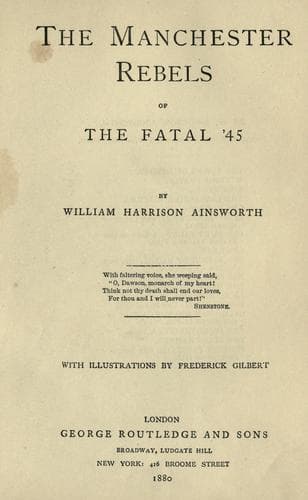
The Manchester Rebels of the Fatal '45Ainsworth, William Harrison
History
The Manchester Rebels of the Fatal '45
Ainsworth, William Harrison
Great Britain -- History -- George II, 1727-1760 -- Fiction; Jacobite Rebellion, 1745-1746 -- Fiction
From inquiries which they now made at a small roadside inn, where they
halted for a few minutes to refresh themselves and their horses, they
ascertained they were within a mile of Rawcliffe Park, and after a
short colloquy with the host, who was very curious to learn what was
doing at Manchester, and who told them he had seen Sir Richard
Rawcliffe ride past some three or four hours ago, they resumed their
journey, and soon arrived at the gates of the park.
CHAPTER XXVII.
RAWCLIFFE HALL.
The domain was extensive, but had a neglected appearance, and did not
possess any old timber, all the well-grown trees having been cut down
in the time of the former proprietor, Sir Oswald Rawcliffe. Neither
was the park picturesque, being flat, and in some places marshy. On
one side it was bounded by the Mersey, and its melancholy look
impressed Atherton as he gazed around.
Still he felt a singular interest in the place for which he could not
account, unless it were that Constance was connected with it.
At length, they came in sight of the old mansion, near which grew some
of the finest trees they had yet seen. The house had a gloomy look
that harmonised with the melancholy appearance of the park.
Atherton had never beheld the place before, yet he seemed somehow
familiar with it. The wide moat by which it was surrounded, the
drawbridge, the gate-tower, the numerous gables, the bay-windows, all
seemed like an imperfectly recollected picture.
So struck was he with the notion that he drew in the rein for a few
minutes, and gazed steadfastly at the antique mansion, endeavouring to
recall the circumstances under which he could have beheld it, but it
vanished like a dream.
Before riding up to the house, he held a brief consultation with the
sergeant, as to how it would be best to proceed.
Hitherto they had seen no one in the park, which, as already stated,
had a thoroughly neglected air; nor, as far as they could judge, had
their approach been remarked by any of the inmates of the house.
Gloom seemed to brood over the place. So silent was it that it might
have been uninhabited.
"If I had not been assured that Sir Richard is at home, I should not
have thought so," remarked Atherton. "The house has not a very
cheerful or hospitable air."
"Luckily, the drawbridge is down, or we might have been kept on the
wrong side of the moat," remarked the sergeant. "My advice is that we
enter the fort before we are discovered, or we may never get in at
all."
Acting upon the counsel, Atherton put spurs to his horse and rode up
to the house, which did not look a whit more cheerful as he approached
it, and without halting to ring the bell, dashed across the
drawbridge, passed through the open gateway and entered the
court-yard, which to the young man's great surprise did not look so
neglected as the exterior of the mansion had led him to anticipate.
Public-domain text, read in full here on John Shaqi.
Reviews
Reviews
No reviews yet
Be the first to share your thoughts on this work.
Elsewhere in the archive
Join the Discussion
Join the discussion
Sign in to leave a comment or review.
Sign InorCreate an account