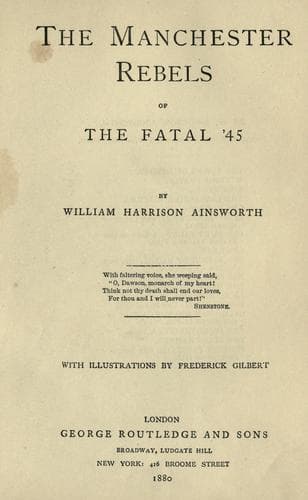
The Manchester Rebels of the Fatal '45Ainsworth, William Harrison
History
The Manchester Rebels of the Fatal '45
Ainsworth, William Harrison
Great Britain -- History -- George II, 1727-1760 -- Fiction; Jacobite Rebellion, 1745-1746 -- Fiction
His meditations were not disturbed by either of his attendants, for
the sergeant was a short distance behind him, and the groom about
twenty or thirty yards in advance. As they trotted on quickly they
were soon out of the park, and were now making their way somewhat more
slowly along the road leading to Warrington. Presently they turned off
on the right, in order to reach the ford, and were skirting the banks
of the Mersey, when Holden came back and said that he perceived some
men armed with muskets guarding the ford.
A brief consultation was then held. As the groom declared that the
river was only fordable at this point, Atherton resolved to go on at
all hazards.
As they drew near the ford they found it guarded--as Holden had
stated--by half a dozen armed militia-men, who were evidently
determined to dispute their passage.
"Stand! in the king's name!" cried the leader of the party in an
authoritative voice. "We can discern that one of you is a Highlander,
and we believe you are all rebels and traitors. Stand! I say!"
"Rebels and traitors yourselves!" thundered the sergeant in reply. "We
own no sovereign but King James the Third."
"Out of our way, fellows!" cried Atherton. "We mean to pass the ford!"
Drawing his sword as he spoke, he struck spurs into his steed, and
dashed down the bank, followed closely by the sergeant and Holden--the
former having likewise drawn his claymore.
The militia-men drew back, but fired at them as they were crossing the
river, though without doing them any harm.
Having escaped this danger, they proceeded at the same rapid pace as
before, and in the same order, the groom riding about twenty yards in
advance. The few travellers they met with got out of their way.
By the time they reached Chat Moss the moon had risen, and her beams
illumined the dreary swamp.
The scene looked far more striking than it did by daylight, but
Atherton gazed at it with a different eye. Other thoughts now occupied
his breast, and he seemed changed even to himself. When he tracked
that road, a few hours ago, he was a mere adventurer--without
name--without fortune--now he had a title and large estates.
Reflections on this sudden and extraordinary change in his position
now completely engrossed him, and he fell into a reverie which lasted
till he reached Pendleton, and then waking up, as if from a dream, he
was astonished to find he had got so far.
From this elevation the town of Manchester could be descried, and as
the houses were again illuminated, and bonfires were lighted in
different quarters, it presented a very striking appearance.
Just as Atherton crossed Salford Bridge, the clock of the collegiate
church told forth eleven; and so crowded were the streets, owing to
the illuminations, that nearly another quarter of an hour was required
to reach the prince's head-quarters.
Atherton was attended only by the groom, the sergeant having gone to
report himself on his return to the Chevalier de Johnstone.
Public-domain text, read in full here on John Shaqi.
Reviews
Reviews
No reviews yet
Be the first to share your thoughts on this work.
Elsewhere in the archive
Join the Discussion
Join the discussion
Sign in to leave a comment or review.
Sign InorCreate an account